
You are holding two carpet samples in a showroom, one marked nylon and one marked polyester.
The cards will not tell you which one will still look good in a hallway with a dog, or whether the soft pad the salesperson suggested voids the warranty.
Pick nylon for high traffic, polyester for stain resistance and colorfastness, and olefin for damp spaces.
Underneath the fiber name sit three measurable specs that decide the outcome: twist level, face weight, and pad density.
Fiber name is a starting point, not the answer.
A pad that is too thick under a looped carpet can wrinkle within months and put the warranty at risk. A low-twist fiber in a busy hallway flattens faster than a pricier one next door.
What separates a good buy from an expensive mistake is the specification sheet, not the price per square foot.
The Direct Answer: Which Carpet Fiber Fits Your Room
Carpet fiber types each carry a different failure mode, so the choice comes down to the room you are carpeting.
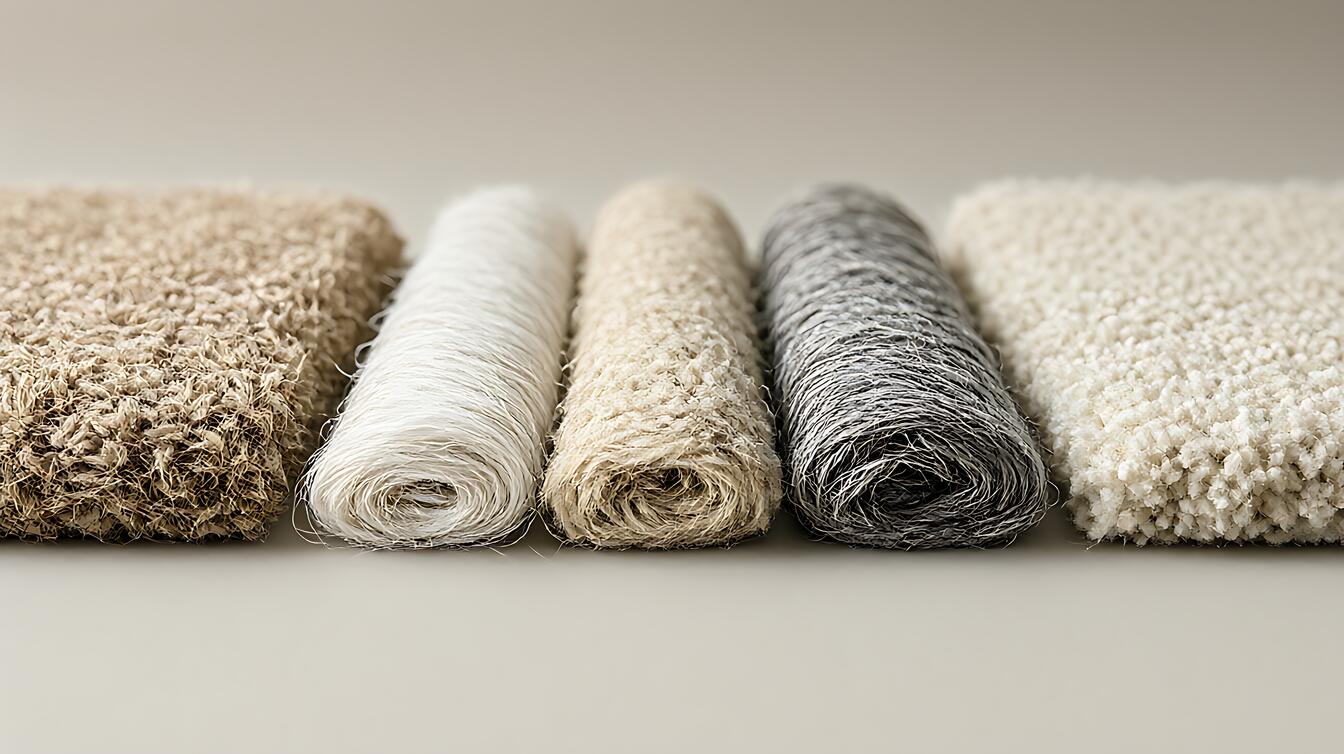
Nylon is the default for most American homes, holding roughly 65% of the market because it takes repeated foot traffic and springs back from compression.
Polyester and olefin are the most colorfast and stain-resistant fibers, which makes either one a sensible pick for a kitchen, dining room or entryway.
Wool is the premium option, lasting 20 to 30 years with proper care. Triexta sits in the middle, with a polymer that is 37% made from corn and a typical lifespan of 10 to 15 years.
Match the fiber to the room’s hardest condition. A hallway with kids and pets needs the resilience of nylon.
A room that sees constant sun needs a fiber with strong colorfastness, though polyester can still fade in direct sunlight, so window treatment matters as much as the fiber.
A basement slab needs the moisture resistance of olefin, a fiber originally developed for outdoor carpeting because it resists moisture and mildew.
For most families, a textured nylon cut pile is the safest default. Its tight twist helps it resist soil, and it hides dirt, footprints and vacuum marks better than plush styles.
Reserve triexta for bedrooms where you want a premium hand without the top price, and treat olefin as a basement and closet material rather than a living room one.
Nylon, Polyester, Olefin, Wool and Triexta Compared
Cost and durability are the two levers here, and they point in opposite directions.
Nylon runs $2 to $5 per square foot and typically lasts 12 to 15 years with proper maintenance. Polyester runs $1 to $3 and lasts 5 to 10 years in average traffic.
Olefin also runs $1 to $3 and lasts 5 to 8 years. Wool costs $4 to $20 but lasts 20 to 30 years.
| Fiber | Cost Per Sq Ft | Lifespan | Where It Falls Short |
|---|---|---|---|
| Nylon | $2 to $5 | 12 to 15 years | Static buildup in dry climates |
| Polyester | $1 to $3 | 5 to 10 years | Low resilience; can fade in direct sun |
| Olefin | $1 to $3 | 5 to 8 years | Crushes in high-traffic rooms |
| Wool | $4 to $20 | 20 to 30 years | Not inherently stain-resistant; harder to clean |
| Triexta | Mid-range | 10 to 15 years | Newer fiber; less widely stocked |
The honest trade-off sits in the middle column. You pay more for nylon because it recovers from compression after furniture sits on it for months.
Polyester feels soft when it is new but flattens faster in busy zones. Adding acrylic fibers to a traffic-control polyester improves its resilience, but the base fiber is still less resilient than nylon.
Wool is naturally soil-resistant, and it can be stretched 30% and still recover its original dimension. It is not inherently stain-resistant, and it is harder to clean and to deodorize.
Acrylic is the value imitation worth knowing about. It gives the look and feel of wool at $3 to $8 per square foot, but it fuzzes and pills easily, which makes it a poor choice for large carpeted areas.
If you want a natural fiber, buy wool properly and accept the cleaning effort rather than settling for acrylic in a room that gets walked on every day.
Read the Specs: Twist Level, Face Weight and Density
Twist level says how tightly the yarn bundles are spun. Most cut pile styles run 3 to 6 twists per inch, while frieze reaches 7 to 9.
Face weight measures the ounces of yarn in a square yard, and a higher number means more material and a longer lasting carpet.
Carpet density describes how tightly the fibers sit together. It is the clearest indicator of how the carpet resists crushing, and it tells you more than the fiber name does.
You can test density without any tools. Press your fingers into the pile; if you easily reach the backing, the density is low and the carpet will mat quickly.
Bend the sample into a U shape with the tufts facing outward. The less backing you can see, the denser the carpet.
The Carpet and Rug Institute puts it more bluntly: you should not be able to see the backing when evaluating a pile style.
Pile height is the fourth measurement worth reading, and it has a limit. The institute recommends a pile height of half an inch or less for high-traffic areas.
A tall, loosely twisted carpet in a busy hallway will flatten out and show vacuum lines within a year.
Be careful with stitches per inch as a stand-alone number, because standards vary widely between styles and fibers. Use it to compare like with like.
Padding: The Spec That Decides Your Warranty
Most carpet warranties state the maximum pad thickness and the minimum pad density in writing, and those two limits are the easiest mistake to make.
For residential cut pile carpet, the Carpet and Rug Institute guidance is a pad no thicker than 7/16 inch and no less than 6 pounds per cubic foot.
For berber and other loop or thin carpets, the maximum thickness drops to 3/8 inch and the minimum density rises to 8 pounds per cubic foot.
Many manufacturers write those same figures into their warranty terms, sometimes with higher minimums of their own.
Padding is a structural component, not just comfort. Density is the weight of one cubic foot of pad, and higher density means firmer support and a longer life.
On stairs, use a firm pad of 8 pounds or more and no thicker than 7/16 inch. A soft pad lets the carpet roll over the nosing and wear through quickly.
For everyday rooms, 6 pounds per cubic foot is the working minimum. Exceed the thickness limit and the carpet flexes too much.
That flex shows up as wrinkles at the seams and edges, which become trip hazards and permanent distortions.
Read the warranty document before you buy the pad, and confirm that it names the exact fiber and construction you have selected.
If it says up to 7/16 inch, do not bring home a half-inch pad for a textured nylon carpet unless that brand explicitly lists it as acceptable. An installer can verify the pair, but the spec sheet is your responsibility to hand over.
This is also the point where a hard surface alternative becomes worth comparing, since the decision leaves the carpet category entirely. The broader trade-offs are laid out in the interior flooring selection guide.
3 Specs That Matter: Your Carpet Buying Decision
Map each room to its own condition, then read the spec card in the same order every time.
For a south-facing room with intense sun, choose a colorfast polyester or olefin and pair it with window shading, because no fiber makes direct sun harmless.
For a basement on a concrete slab, choose olefin for its moisture and mildew resistance. Treat the moisture question itself with the basement flooring solutions guide before you settle on any flooring at all.
For a hallway or stair run with heavy foot traffic, choose nylon with a high face weight and a tight twist, and add a firmer pad.
For a quiet bedroom, choose triexta or wool for comfort and longevity, and let the pile height go higher.
If you have pets, favor nylon over olefin, and check whether the fiber is an antistatic version, since static builds up easily in nylon in dry climates.
If you plan to resell the home, nylon is the safe resale choice because it is the durability standard of the trade.
Color choice changes the maintenance burden too. Mid-tones and multi-tonal patterns hide footprints, spills and dirt better than solid light or dark colors.
If you are moving between carpet and hard flooring, plan the edge properly with types of flooring transition strips.
And if the kitchen or entryway is really the problem, read the laminate flooring buying guide before committing to more carpet.
The decision comes down to three things you can verify before you pay.
Choose nylon when durability in a traffic zone matters most, choose polyester or olefin when stain resistance and moisture do, and choose wool when you want a natural fiber and can live with the cleaning.
Then confirm the twist level, the face weight and the pad thickness and density against the warranty card, and your installer will have nothing to guess about.