
Standing in a supply yard with rolls of fabric stretching across the floor, you need to stop guessing and start calculating. The right gauge balances wire thickness against your specific site load and budget. A 9-gauge chain link fence is a welded wire system that uses a 0.119-inch diameter strand, offering a balance of strength and cost that suits most residential and standard commercial projects.
Chain Link Fence Gauge Options: 6, 9, 11 & 11.5 Wire Diameter Specs
Four standard gauges handle 95% of fencing jobs. The difference is not just wire size; it changes how the fabric bends, resists impact, and lasts in your climate. A lower gauge number means thicker, heavier wire. In practice, a 6-gauge fence uses wire nearly twice as thick as an 11-gauge, creating a barrier that resists serious impact.
For most homeowners, 9-gauge fabric is the sweet spot. It contains roughly 71% more steel mass per linear foot than the standard 11.5-gauge option. This extra weight adds durability without the price jump of commercial-grade heavy gauges. If you plan to keep the fence for 10 to 20 years, staying at 9-gauge or thicker is the baseline recommendation.
Budget-conscious projects often start with 11-gauge or 11.5-gauge fabric. These thinner wires are lighter and cheaper per roll, but they bend more easily under wind or impact. The trade-off is clear: you save on material upfront but face a shorter service life and higher risk of deformation. If your priority is a temporary barrier or low-traffic area, these thinner options work well.
| Gauge | Wire Diameter (in) | Primary Use | Cost Factor |
|---|---|---|---|
| 6 | 0.192 | High-security / Commercial | Premium |
| 9 | 0.119 | Residential / Standard Commercial | 30-45% higher than 11 |
| 11 | 0.104 | Light Residential / Decorative | Standard |
| 11.5 | 0.097 | Temporary / Low-Traffic | Lowest |
Coating & Slat Systems: Durability vs Privacy Trade-Offs
Wire durability depends on the coating and the environment. Galvanized steel resists rust through zinc, but coated options add color and protection. In high-humidity or coastal areas, a vinyl-coated layer acts as a barrier against moisture, extending the life of the wire strand beyond what bare galvanized offers. You must match the coating to your local weather patterns.
Privacy is a separate variable from strength. Standard chain link is open mesh, allowing full sightlines. If you need seclusion, you attach slats to the fabric. Solid slats block view but add weight to the frame. The slat system increases wind load, so you may need to step up to a heavier gauge to prevent sagging. A 11-gauge fence with solid slats behaves differently than a 9-gauge fence with open mesh.
Color choice also impacts heat absorption. Dark coatings absorb more sun, which can degrade plastic components over time. Lighter colors reflect heat and maintain structural integrity in high sun exposure. If your fence faces direct southern sun, choose a light-colored coating to reduce thermal stress on the coating layer. This small detail preserves the material’s flexibility and appearance for years.
Installation Tolerances: Post Depth, Span, & Slope Handling
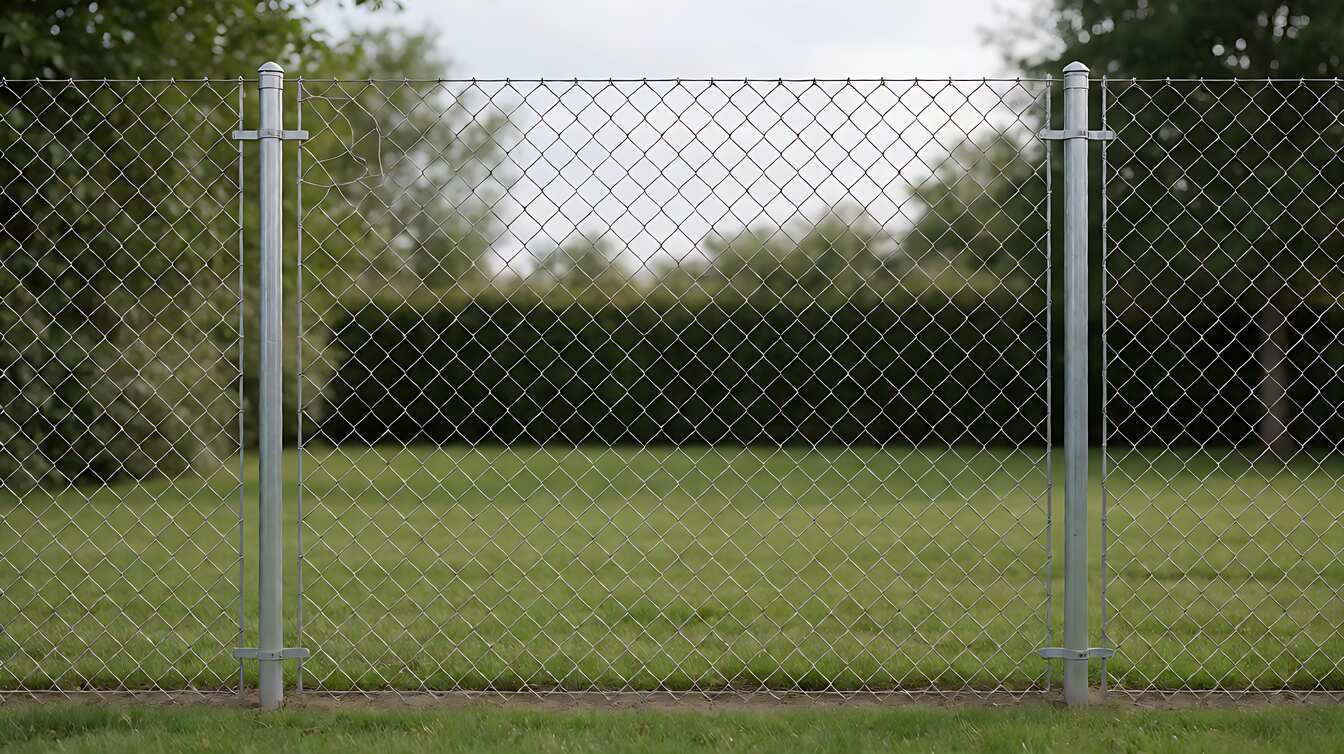
Correct installation saves you from sagging and failure. Post depth is the critical dimension. For a 6-foot fence, dig posts at least 1.5 feet deep into stable soil. This ratio keeps the fence upright against wind. If your site has a slope, you use stepped posts rather than a straight line to maintain uniform fabric height. Each post should sit on a level pad to distribute load evenly.
Post spacing dictates fabric tension. Standard spans run 8 feet between posts, but heavy gauges or high-wind zones require 6-foot spans. Tighter spacing prevents the fabric from billowing and reduces the risk of wire breakage at attachment points. You measure span distance on the ground before ordering posts to avoid buying too much or too little material. A 10% waste allowance covers site irregularities.
For steep slopes, adjust the top rail to follow the ground contour. This keeps the mesh bottom close to the soil line without gaps. If the slope exceeds 2%, you must use a stepped installation method. This prevents the fabric from stretching diagonally, which weakens the weave. A contractor should handle slopes above 3%, as DIY tensioning becomes difficult and error-prone on severe grades.
Common Mistakes & When to Call a Pro
Most DIY failures come from under-specifying the hardware. A common trap is using lightweight posts for a heavy gauge fence. If you install 6-gauge fabric, you need thicker, deeper posts to support the weight. Mismatched components cause the top rail to sag within months. Check the load rating of your post brackets against the total weight of the fabric and slats.
Another frequent error is ignoring drainage. Water pooling at post bases accelerates rust in the lower 6 inches of the steel. You grade the ground to slope away from posts and use gravel at the bottom of post holes to promote drainage. If your site has poor drainage, a professional assessment is wise to prevent premature structural failure. waterproofing systems for the post base area can extend life significantly.
When to call a pro: If you have high-security needs, slopes over 3%, or commercial building codes to meet. DIY works for standard residential areas with flat ground and 9-gauge or lighter fabric. For complex sites, a licensed installer ensures code compliance and proper tensioning. Compare local fencing materials comparison guides to verify if a pro is necessary for your specific zone.
Decision Guide: Matching Gauge to Your Site Conditions
Choose 9-gauge if you want a balance of strength and cost for residential use. This gauge lasts 10-20 years and handles standard wind loads. It is the default choice for most homeowners who want a durable, low-maintenance boundary.
Choose 11-gauge or 11.5-gauge if your budget is tight and the fence serves a low-traffic purpose, like marking a property line. These options save 30-45% on fabric cost but offer less impact resistance. They suit temporary setups or areas where privacy and strength are secondary.
Choose 6-gauge for high-security commercial applications or perimeter defense against vehicles. This heavy wire resists serious impact and intrusion attempts. The cost is high, but the security benefit justifies the premium in industrial or corporate settings. Pair it with a robust paint and coating system for maximum longevity in harsh conditions.