
Three quotes for “privacy fence” may list $18, $29, and $40 per linear foot while specifying different post depths, materials, and hardware. Compare the scope before comparing the prices. Residential fencing materials include chain link, wood, vinyl, aluminum, and composite; the right choice depends on privacy, climate, maintenance tolerance, and what is happening underground.
Five Fencing Materials Compared by Cost, Life, and Maintenance
Residential fencing materials differ sharply in installed cost per linear foot and expected service life. Published prices vary by region, height, gates, slope, removal, and labor, so online figures can differ by as much as two times. A written quote remains the only useful comparison.
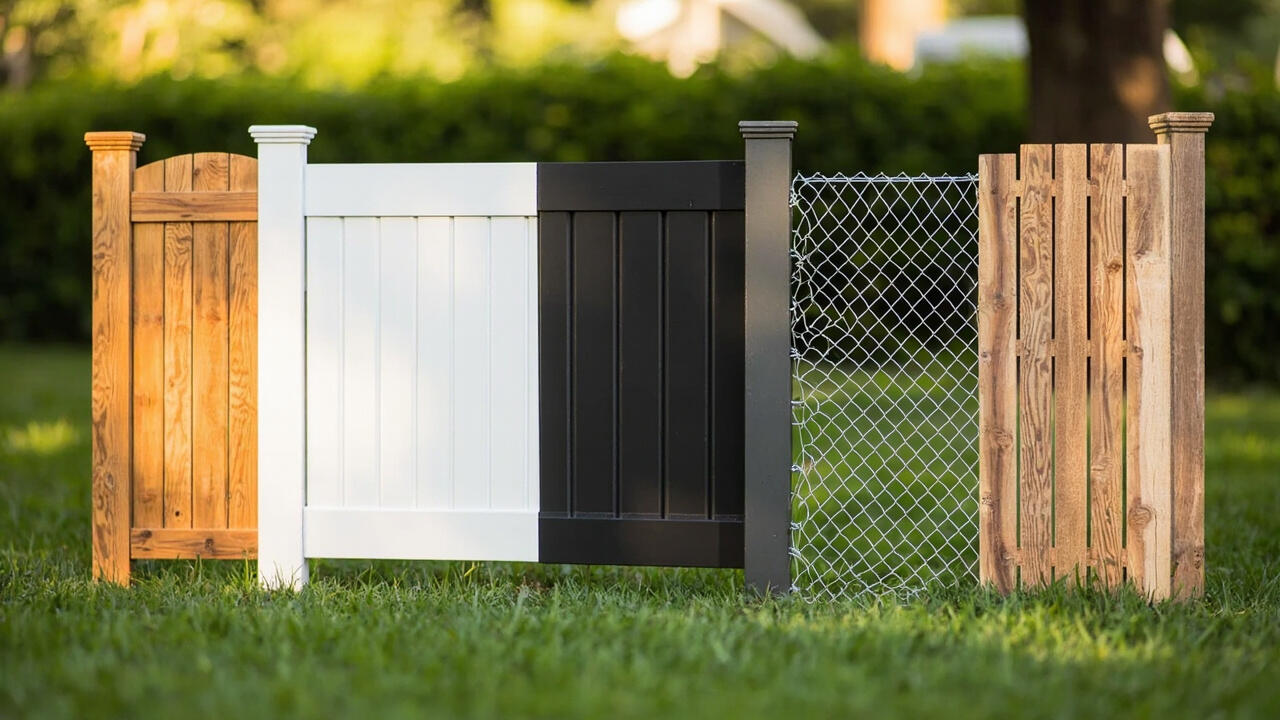
Typical installed ranges are broad planning figures, not bids: chain link often runs $8 to $18 per linear foot, wood $18 to $40, vinyl $25 to $50, aluminum $30 to $60, and composite $35 to $65. Ask each contractor to identify the exact grade, height, post spacing, gate allowance, and finishing work.
| Material | Installed planning range | Typical service life | Privacy and maintenance | Best fit |
|---|---|---|---|---|
| Chain link | $8 to $18/ft | 15 to 25 years | Open; low maintenance, tension may need adjustment | Budget and visibility |
| Wood | $18 to $40/ft | 15 to 25 years | Full when boarded; staining or painting needed | Natural appearance and repairability |
| Vinyl | $25 to $50/ft | 20 to 35 years | Full; cleaning is usually simple | Low-maintenance privacy |
| Aluminum | $30 to $60/ft | 30 to 50 years | Open to full; corrosion finish is critical | Coastal sites and open boundaries |
| Composite | $35 to $65/ft | 20 to 35 years | Full; less staining, but color fades | Wood appearance without routine refinishing |
For a detailed product decision, compare the same structure that governs any two exterior systems, including exterior waterproofing membrane vs coating. Match the product to the site conditions, not merely to a headline material.
Post Depth Below the Frost Line Decides Service Life, Not the Board
Post depth below the frost line can determine fence life even when the board material is durable. A common planning range is 30 to 42 inches, but the governing rule is depth below the local frost line, not a universal number. Local code, soil, slope, drainage, and fence height still control the final specification.
For wood posts, check the ground-contact lumber rating. UC4A or UC4B is intended for exterior ground-contact exposure and is stronger protection against rot than UC3B, which is not appropriate for buried posts. A low-cost rail can fail while the boards above it still look excellent.
Drainage matters just as much as depth. Backfill compacted around a post can trap water against the base; coarse gravel around the lower post can improve drainage when local practice permits. In clay soil, standing water and frost expansion can pry a fence out of alignment. The same principle applies to drainage behind a retaining wall, where trapped water creates movement and decay.
Ask the contractor to write the post depth, concrete or gravel detail, soil assumptions, and footing responsibility into the quote. A licensed contractor should confirm structural footings and permit requirements, especially where frost is deep or the ground is unstable.
Hardware and Fasteners Fail Before the Fence Body
Hardware corrosion grade is often the weakest link in a coastal salt air installation. Grade-316 stainless is the sensible coastal specification for exposed fasteners and hinges because it resists chloride corrosion better than grade-304; it costs more, but replacing loose hinges or rusting brackets is frustrating.
Mixed metals can trigger galvanic corrosion, in which one metal sacrifices itself while touching a less compatible metal. Use matched hardware, compatible coatings, and an isolation detail where dissimilar materials are unavoidable. Cut ends of aluminum components also need proper finishing because their exposed layers can weather differently.
Chain link has its own connection check. Field-cut wire, tension fittings, and welds should be inspected after storms or seasonal movement. Check gate sag, latch alignment, and loose tension bars annually, with extra attention after high wind. Wood screws should be exterior-rated and driven so they do not split wet end grain.
A simple inspection habit catches failure early: look for rust staining, loose hinges, cracked brackets, sagging gates, and soil splashing onto wood. Replace a small hardware component before corrosion travels into the post or rail.
Wind Load and Panel Area: Why a Solid Privacy Fence Is a Sail
Wind load rises with panel area, so a solid privacy fence catches more pressure than an open picket or chain link design. That force travels through rails and posts into footings. Post spacing must therefore suit the fence style and height, not merely match a generic installation diagram.
For pets, a privacy rating matters less than containment and climb resistance. A six-foot fence can contain a dog only when the design resists digging, climbing, and pushing. A kickboard may close the bottom gap, but it can also collect wind pressure, so the posts and footings must support the added area.
The trade-off is clear: more privacy means less airflow and greater wind demand. Choose an open design when ventilation and a lower wind load matter more than screening. Choose solid boards when privacy is essential, then verify the complete post, rail, and footing system rather than assuming sturdy boards solve the structure.
Code-bound boundaries deserve special care. Pool-adjacent gates and self-closing latches may require different clearances, heights, and hardware than an ordinary garden fence. For comparison, check deck railing code, height, and baluster spacing, then ask a licensed contractor which rules apply to the fence and pool gate.
Cost Per Year of Service and How to Choose for Your Site
Cost per year of service reframes the cheapest bid. At $18 per linear foot, a 25-year fence costs about $0.72 per year; at $40, the same 25-year span costs $1.60, before inflation, repairs, and maintenance. A higher price can be rational when it removes staining or protects the entire installation.
Choose chain link when your budget is tight and you want an open boundary. Choose wood when the natural look matters and you will maintain the finish. Choose vinyl for dependable privacy with less upkeep, especially when you value the written warranty. Choose aluminum near salt or around an open pool boundary, and choose composite when you want a wood appearance without staining.
Before signing, require written installed cost per linear foot, fence height, post depth, post spacing, ground-contact rating, concrete or gravel detail, hardware grade, gate price, removal cost, and disposal terms. Add slope, drainage, wind exposure, and permit work to the same scope.
Choose composite over vinyl when appearance and color selection outweigh the higher upfront cost. Choose wood over composite when repairability and lower initial cost matter more than routine refinishing. In coastal salt air, require compatible corrosion-resistant hardware. If you cannot define the soil, frost, slope, or wind conditions, consult a licensed contractor before moving forward.