
A dripping tap behind the bathroom vanity wastes roughly 10 litres of water a day, and the first sign is often a faint damp patch on the back panel during a humid summer. Fixtures in a bathroom renovation are the elements that deliver, control, and drain water: taps, shower valves, showerheads, toilets, vanities, and the hardware that ties them together. Selecting them before the plumbing rough-in is locked keeps the renovation on schedule.
In humid subtropical climates, fixture performance depends on three variables most homeowners overlook: internal valve material, seal durability under constant moisture, and whether the household pressure matches the product specification. Brass and stainless steel internals resist corrosion; chrome-plated zinc corrodes within months when humidity sits above 70%.
How Bathroom Fixtures Actually Work
Every bathroom fixture is a controlled barrier between pressurised water and the room. A tap mixes hot and cold through a cartridge or compression valve. A shower diverts flow through a diverter and a pressure-balanced or thermostatic valve. A toilet flushes through a siphon or washdown mechanism that reseals with a rubber flapper.
The component most people never see, and the one that fails most often, is the cartridge inside the tap body. Ceramic disc cartridges last longer than rubber washer assemblies, but only when the water supply is filtered and pressure stays within the rated range.
Senior installers tend to check water pressure with a gauge before finalising tapware orders. A system delivering 800 kPa behaves very differently from one at 250 kPa, and catalogues do not always make that distinction obvious. The most common post-handover failure is not a defect but a mismatch between household pressure and valve specification, causing the cartridge to wear within 12–18 months.
Fixture Types and Their Specific Roles
A standard bathroom renovation typically includes a basin tap, a shower mixer or thermostatic valve, a showerhead, a toilet, a basin or vanity sink, and potentially a bathtub and spout. Each has a different failure profile and a different installation window.
Basin Taps and Mixers
A basin mixer handles both temperature and flow in a single unit. Single-lever mixers use a ceramic disc cartridge that mixes hot and cold through a sliding mechanism. Dual-lever taps use separate cartridges, adding a second failure point. Wall-mounted mixers require the plumbing rough-in to be set into the wall before tiling, so they must be selected early.
Budget basin mixers range from AUD 120 to AUD 300 per piece. Mid-range options sit between AUD 300 and AUD 700. Premium finishes like brushed brass or matte black start around AUD 700. The price difference is usually the cartridge material: brass and ceramic disc in mid-range versus rubber washer in budget. In humid climates, the cartridge material matters more than the surface finish because internal corrosion causes the drip.
Shower Valves and Showerheads
A pressure-balanced valve adjusts for fluctuations in hot or cold supply pressure. A thermostatic valve holds a set temperature regardless of pressure changes, which is more precise and reduces scalding risk.
Mineral buildup in hard water areas clogs the nozzle pattern within 18–24 months. Silicone nozzles are easier to descale than fixed brass. Full bathroom tapware sets, covering basin mixer, shower mixer, bath spout, and toilet button, range from AUD 600 at budget level to AUD 1,500–2,000+ for premium ranges.
Toilets
Budget close-coupled models cost AUD 400–500. Premium wall-hung or smart systems range from AUD 650–2,500+. Wall-hung toilets require a concealed cistern frame (AUD 300–600 extra) plus wall reinforcement. Rimless designs improve hygiene, and dual-flush mechanisms save water. The wax ring that seals the toilet to the floor flange is the component most often overlooked, and its degradation allows water to seep at the base.

Vanities and Sinks
Cabinet materials determine vanity longevity. Solid wood and marine-grade plywood hold up well; MDF swells when water penetrates the finish; particle board is unsuitable for bathroom environments. Sink types include undermount, drop-in, and vessel. The faucet hole configuration must match the vanity top drilling before the countertop is fabricated, which is another reason fixture selection happens before the vanity is ordered.
Hardware and Accessories
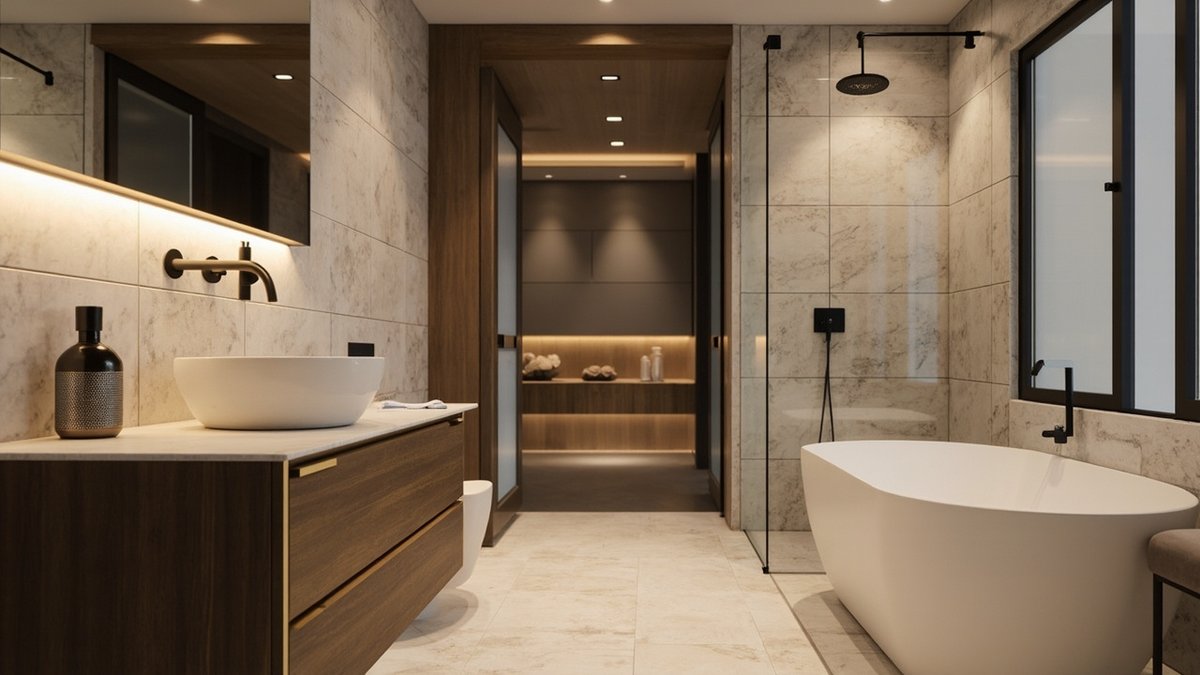
Towel rails, robe hooks, toilet roll holders, and cabinet pulls complete the fixture package. They do not carry water pressure, but mismatched metals create an unplanned look. The current design trend moves toward mixed metals, where a matte black faucet pairs with brushed brass hardware and chrome lighting. This works when deliberate; it looks unfinished when accidental.
What Determines Fixture Durability
Longevity is driven by material quality, water chemistry, and installation accuracy. A brass-bodied tap with a ceramic disc cartridge outlasts a zinc-alloy body with a rubber washer because corrosion resistance is a material property, not a marketing claim. Hard water accelerates mineral buildup; in high-calcium areas, descaling every 12 months is practical maintenance.
In tropical climates where humidity regularly exceeds 70%, condensation on cold-water pipes adds moisture inside wall cavities. This accelerates corrosion on any exposed ferrous component. Stainless steel and brass resist this; chrome-plated zinc does not.
Common Mistakes That Cost More to Fix
The most expensive mistake is selecting fixtures after the plumbing rough-in is complete. Changing a wall-mounted basin mixer after tiling means removing tiles, cutting into the wall, and retiling, adding AUD 1,500–3,000 to the project. The second mistake is choosing a vanity tap without checking the faucet hole configuration of the vanity top. A widespread faucet needs three holes at specific spacing; a single-hole mixer needs one. Once drilled, the countertop cannot be redrilled without replacement.
The third mistake is ignoring water pressure. A rain showerhead designed for low-pressure systems produces weak spray on a high-pressure system without a pressure-limiting valve. Checking pressure with a gauge before ordering prevents this frustration. The fourth is skipping the wax ring seal when replacing a toilet, allowing water to seep at the base with every flush.
When Fixtures Make Sense to Prioritise
Fixtures should be the first decision in a renovation, not the last, because every other trade depends on the specification. The plumber needs rough-in heights, the tiler needs shower screen dimensions, and the electrician needs lighting positions relative to the vanity. Selecting fixtures in the first week keeps the timeline on track.
Verifying Specifications Before Purchase
Before committing to any fixture, verify three things: the water pressure range, the rough-in dimensions, and the mounting compatibility. Pressure can be tested with a gauge available at hardware stores. Rough-in dimensions are measured from finished floor to valve centre, typically 1,000mm for a shower mixer and 200mm for a basin waste. Mounting compatibility covers wall reinforcement for concealed cisterns, stud backing for floating vanities, and floor type for toilet flanges. Skipping this verification is the most common cause of post-installation callbacks.


![Deck Railing Code: Height & Baluster Spacing Guide [IRC ]](https://www.terasly.com/wp-content/uploads/deck-railing-code-height-baluster-featured.jpg)