
You’ve seen it on a café benchtop, a pub toilet door, or a hospital corridor wall. High pressure laminate (HPL) is one of the most common decorative surfacing materials in fit-out work, but most readers don’t know what makes it different from the other laminates on the shelf.
The label “laminate” covers a family of products: the thinner low pressure laminate (LPL) on flat-pack cabinets, the click-together stone plastic composite (SPC) flooring sold everywhere, and HPL proper. Picking the wrong one is the most common cause of a swollen benchtop or peeling cubicle door. HPL is its own category with its own standards — BS EN 438 in Europe and AS/NZS 2924 in Australia and New Zealand, plus JIS A 5905 and CARB Phase 2 for emissions — and asking for the standard by name is the contract that protects the buyer.
This pillar covers what HPL is, how it stacks against LPL and SPC, where it earns its place, what fails in the field, and when to escalate. By the end you should be able to read an HPL data sheet and decide whether HPL is the right surface for your project.
What Is High Pressure Laminate (HPL)?
High pressure laminate is a composite panel made by bonding layers of paper with thermoset resin under high heat and pressure. The paper stack is the heart of the material: a core of kraft paper (the same brown paper used in shipping sacks, but bleached and treated) soaked in phenolic resin, topped with a printed or solid-colour decorative paper soaked in melamine resin. When the layers are pressed together at the pressures and cure temperatures defined by BS EN 438-2 or AS/NZS 2924.1 — the heat and pressure thresholds that separate high pressure laminate from low pressure laminate — the resin crosslinks irreversibly. The result is a single fused sheet that cannot be remelted or reshaped, which is why HPL behaves differently from the thermoplastic surfaces people sometimes confuse it with.
The relevant standard for any HPL product you specify is BS EN 438, the European standard for high-pressure decorative laminates, or its Australian twin, AS/NZS 2924. Both cover the same performance criteria — thickness tolerance, abrasion resistance, impact strength, stain resistance, colour fastness, and dimensional stability under heat and moisture. If a supplier can’t tell you which standard their HPL meets, that’s a flag worth pausing on. The grade code on the data sheet (HGS, HGP, VGS, CGS) tells you how the panel is intended to be used: horizontal general-purpose, horizontal post-forming, vertical general-purpose, or compact grade for thick, self-supporting panels. Match the grade to the application, and the standard is your contract.
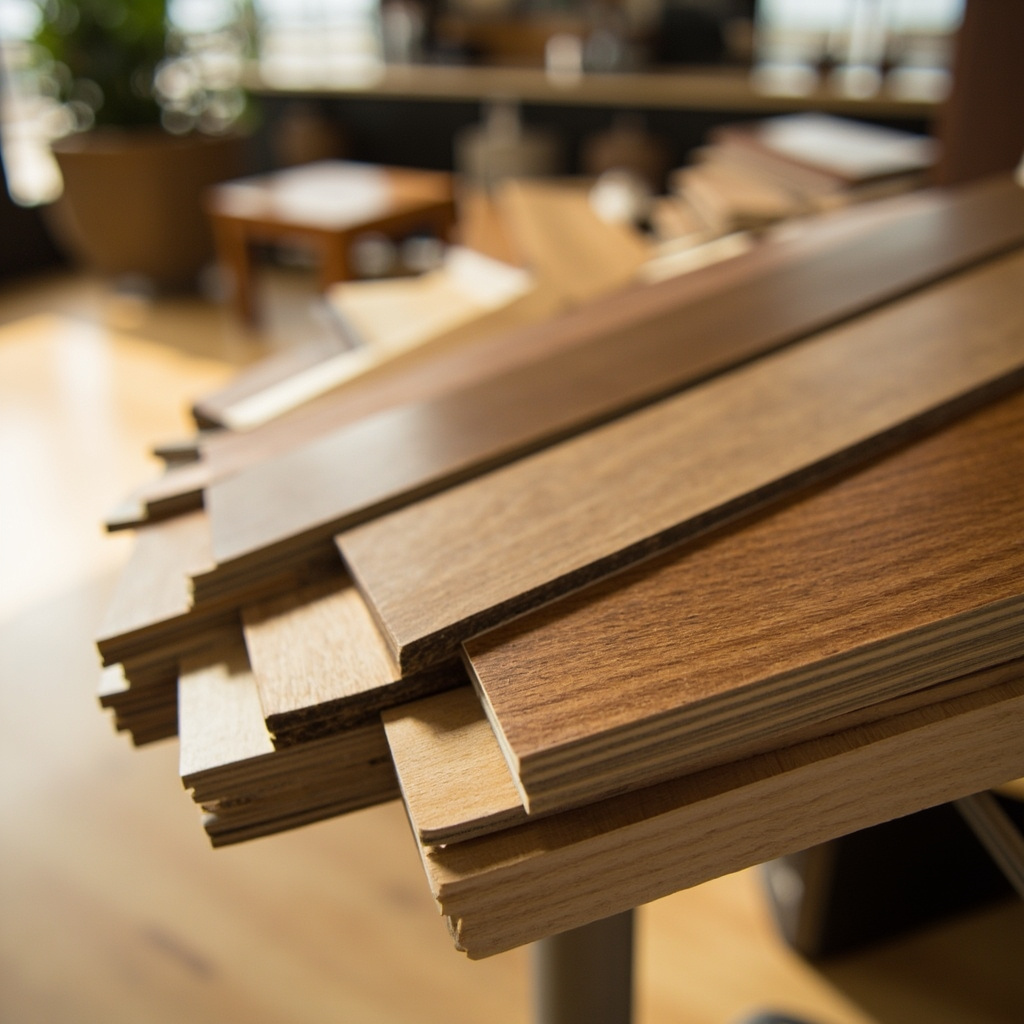
HPL is dense, hard, and repair-resistant. A 0.7 mm HPL sheet bonded to a substrate is the classic kitchen benchtop build-up used in millions of homes. A 12 mm thick compact-grade HPL panel — also called solid phenolic — is its own structural panel, used for toilet cubicles, laboratory worktops, locker doors, and exterior cladding. Both are HPL; the difference is thickness, density, and grade. Standard 0.7 mm HPL needs a substrate (MDF, particleboard, plywood); compact-grade HPL doesn’t.
How HPL Is Made — The Process That Gives It Strength
The two-stage manufacturing process is what gives HPL its durability story, and it’s worth understanding before comparing it to cheaper laminates.
Stage 1: Impregnation
Rolls of kraft paper are pulled through a resin bath of phenolic resin, the same family of resins used in circuit boards. The paper absorbs the resin and excess is scraped off by precision rollers. The decorative surface paper runs through a separate bath of melamine resin. Both are dried in towers, where the resin partially cures to a stable, tack-free state. The dried, resin-saturated sheets are called “resin paper” or “impregnated paper,” and they are the raw material for the press.
Stage 2: Pressing
The resin paper is cut into sheets and stacked: a typical 0.7 mm HPL build-up has several kraft core layers plus one decorative surface layer, sometimes with an overlay sheet on top for extra abrasion resistance. The stack goes into a multi-daylight press — each “daylight” is one open shelf heated by steam or thermal oil. The press closes to high pressure at cure temperatures typically above 120 degrees C. The resin cures fully, the layers fuse irreversibly, and the panel emerges as a single homogeneous sheet.
Three things follow from this process that matter in the field. First, HPL is a thermoset composite, not a thermoplastic — it cannot be remelted or reshaped after curing. That’s why a scorched benchtop can’t be sanded smooth the way a damaged solid-surface counter can. Second, the densification under high pressure gives HPL its impact and abrasion resistance: standard HPL rated to EN 438-2 typically achieves at least 400 Taber revolutions, with heavy-duty grades over 1,000. Third, the kraft paper layers give HPL its characteristic edge — a dark phenolic core of fine dark lines on cross-section. That edge needs sealing in wet areas; more on that in the failure section.
Compact-grade HPL follows the same process but with many more kraft layers and much higher pressure. The result is a self-supporting panel that doesn’t need a substrate, with the same material through its full thickness — which is why a compact-grade toilet partition can take a slammed door and keep going.
HPL vs LPL vs SPC — How the Three Compare
The three laminates people most often confuse are HPL, LPL, and SPC. They sound like a sequence — low, high, in-between — but they’re three distinct products with three different manufacturing processes, three different standards, and three different jobs. The table below lines them up, then the rest of the section walks through what each one is actually for.
| Attribute | HPL | LPL | SPC |
|---|---|---|---|
| Pressing pressure | High (per BS EN 438-2 / AS/NZS 2924.1) | Low (< 7 MPa) | Extruded, no pressing |
| Core material | Kraft paper + phenolic resin | Kraft paper + resin | PVC + limestone filler |
| Relevant standard | BS EN 438, AS/NZS 2924 | EN 438 (low-pressure variant), proprietary | ASTM F3261 (rigid core vinyl) |
| Typical thickness | 0.5 — 1.2 mm veneer, or 3 — 25 mm compact | 0.2 — 0.6 mm | 3.5 — 8 mm with wear layer |
| Best fit | Benchtops, cubicles, wall cladding, lab tops | Cabinet interiors, furniture faces, shelf linings | Click-lock flooring in dry and moderately wet areas |
| Heat behaviour | Thermoset — doesn’t soften | Thermoset but thinner | Thermoplastic — can soften in direct sun |
| Substrate needed | 0.5 — 1.2 mm grade needs substrate; compact doesn’t | Yes, always | No — rigid plank with built-in underlayment |
There’s also CPL (continuous pressed laminate), which is HPL made in a continuous roll rather than batch-pressed sheets. CPL behaves like HPL for most purposes and is rated to the same EN 438 standard, but the thinner format allows post-forming around tight radii — useful for curved benchtop edges. If a fabricator offers to bend an HPL sheet around a tight corner, they’re probably using CPL or a specifically post-forming-grade HPL, not standard HPL. The grammar of these products matters: HPL is a category, not a brand, and within it there are different grades for different jobs. The comparison deep-dive lives in the HPL vs LPL vs SPC guide.
Where HPL Works Best — The Honest Application List
HPL’s strengths are density, scratch resistance, stain resistance, and the ability to be specified for heavy commercial use. Those same strengths make it heavy, rigid, and unforgiving of bad substrate preparation. Here’s where it earns its keep and where it doesn’t.
Strong fits
Kitchen benchtops are the canonical residential use, alongside bathroom vanity tops and laundry counters. A 0.7 mm HPL face bonded to moisture-resistant MDF or plywood, with a matching backer sheet underneath, gives a serviceable work surface at a price most renovations can absorb. A 38 mm or 40 mm thick build-up front edge is standard in modern kitchens. Compact-grade HPL (12 mm thick) is also used as a self-supporting benchtop in commercial kitchens and outdoor BBQ benches.
Cubicle partitions are HPL’s most visible commercial use. Toilet cubicles, shower partitions, and changing-room dividers are almost always compact-grade HPL in 12 mm or 18 mm thickness, finished in a solid colour or woodgrain pattern. The panels are self-supporting, hard-wearing, and cleanable with standard disinfectants — which is why they’re specified in airports, schools, and hospitals. The HPL toilet partitions guide goes deeper on the cubicle specification specifically, including thickness, hardware, and ceiling clearance.
Wall cladding and column casings in commercial lobbies, hospital corridors, and clean rooms use HPL bonded to a frame or directly to plasterboard. The fire performance can be tuned: standard HPL achieves a Class 2 surface spread of flame under BS 476, and fire-rated grades achieve Class 1 or Class 0 with the right build-up. Exterior-grade HPL panels (such as those from Trespa or Alpolic) carry an exterior warranty, are UV-stable, and need an installer certified by the manufacturer to keep that warranty alive.
Laboratory worktops and medical surfaces benefit from HPL’s chemical resistance. Compact-grade HPL passes the chemical spot tests in EN 438 for many laboratory reagents — if the worktop will see strong acids or solvents, specify a chemical-resistant grade.
Weak fits
Flooring in heavy foot traffic. HPL isn’t engineered for underfoot loading or the repeated flex that click-lock flooring takes. It’s too rigid, too thin, and too prone to localised impact damage under foot. Use SPC, LVT, engineered timber, or ceramic for floors; HPL for the wall behind the floor.
Wet edges. HPL is moisture-resistant across its face but not at cut edges. Exposed kraft paper core is hygroscopic — it wicks water and swells. The fix is sealed edges (closed-cell silicone or HPL edge band), but in an unseamed wet area where sheets sit in standing water, HPL fails predictably. Pick a different material.
Tight post-formed curves. Standard HPL is rigid. The thinnest grades (0.5 mm) can take a gentle radius, but a tight curve around a cabinetry corner needs post-forming grade (HGP) or CPL. Specify the grade before specifying the shape.
How to Read an HPL Data Sheet — What Buyers Actually Need
An HPL data sheet isn’t consumer literature. It’s a technical document with numbers, and knowing which numbers matter turns a confusing page into a clear specification. Here’s what to look for — and what to ask the supplier about each line.
Thickness and grade
For vertical applications (wall cladding, cabinet doors, locker fronts), 0.6 — 0.8 mm HPL bonded to a substrate is the standard build. For benchtop and counter faces, 0.7 — 1.2 mm is more common. Compact-grade panels run from 3 mm to 25 mm and don’t need a substrate. The grade code on the data sheet tells you the manufacturer’s rated use: HGS (horizontal general-purpose), HGP (horizontal post-forming), VGS (vertical general-purpose), CGS (compact grade, structural). Match grade to use; HGS on an exterior facade is an unspecified use.
Fire rating
HPL is combustible — it’s paper and resin — but it can be formulated to meet a range of fire-rating standards. In Australia, the relevant reaction-to-fire tests are AS 1530.3 (spread of flame, smoke developed, ignitability indices) and AS 5637.1 for wall and ceiling linings. In Europe, the relevant classification is Euroclass B-s1,d0 or better, per BS EN 13501-1. The data sheet should list a tested rating, not a generic “fire-rated” claim. For commercial fit-outs with BCA / NCC compliance requirements, the fire rating often dictates the build-up.
Emissions certification
Formaldehyde emissions from phenolic and melamine resins are the historical concern with HPL. Modern HPL is low-emitting, and reputable manufacturers carry third-party certification: CARB Phase 2 (California Air Resources Board), E1 (European low-emission class), or E2 (the older, higher-emission class — worth avoiding for indoor use). If the data sheet doesn’t name a certification, ask which test method was used.
Other data sheet fields
Abrasion resistance is rated in Taber revolutions (typically 400 — 1,000+ for HPL). Stain resistance is rated against a reagent list per EN 438-2 — usually Group 1, 2, and 3 ratings. Impact resistance is rated in newton-metres for ball-drop tests. Light fastness is rated on a blue-wool scale (typically 6 — 8 for interior HPL). If the project has a daylight-exposed or UV-exposed surface, the light fastness rating matters more than the abrasion rating.
What the buyer should ask: “What’s the standard? What’s the grade? What’s the fire rating? What’s the emissions certification?” — and a fifth, often-forgotten question: “What’s the warranty, what’s covered, and what’s excluded?” If the supplier can’t produce that information cleanly, walk on to one that can.
What Goes Wrong with HPL — The Failure Modes That Matter
Most HPL failures aren’t failures of the laminate face. They’re failures of the edge, the substrate, or the adhesive. The HPL itself does its job; what’s around it lets the assembly down. Knowing the failure modes is the difference between a 20-year install and a 3-year rebuild.
Edge swelling at unsealed cuts
The single most common HPL failure is a swollen, cupped, or delaminated edge near a sink, tap, or shower. The face looks fine; the edge near the wet zone has lifted by 2 — 5 mm. The cause is moisture wicking into the exposed kraft paper core along a cut edge that wasn’t sealed at install. The fix is preventive: every cut edge gets a closed-cell silicone sealant, an HPL edge band, or a poured epoxy seal before the panel is fitted. Once it’s lifted, the panel usually needs re-laminating or replacing.
Delamination from the wrong substrate
Standard interior MDF wicks moisture and swells when it gets wet. If you bond HPL to it in a vanity top or a kitchen near a sink, the substrate moves more than the HPL face, the bond line fails, and the laminate lifts. Use exterior-grade MDF (also called moisture-resistant MR MDF) or marine plywood under HPL in any wet or semi-wet location. The substrate has to be rated for the same environment the face is rated for.
Adhesive failure
The cheapest contact adhesives soften in heat. Near a kettle, a coffee machine, or behind a window where sun hits the back of a panel, the bond creeps and the laminate bubbles. Use a heat-resistant adhesive (a PVA-type crosslinking adhesive or a two-part epoxy) for any surface that sees sustained heat above 50 degrees C, and read the adhesive data sheet as carefully as the HPL sheet.
Impact damage near edges
Compact-grade HPL is tough through its thickness, but the edge profile is vulnerable. A hard knock near the edge of a cubicle door can chip the phenolic core. Router-cut edges with a clean finish are stronger than score-and-snap edges, which leave micro-cracks that propagate under impact.
UV fade on exterior HPL
Standard interior HPL fades in direct sunlight. Exterior-grade HPL uses UV-inhibited overlay layers and is rated for outdoor service, but only if it’s installed with the right fixings and joint details. If the spec calls for outdoor HPL, ask for the manufacturer’s installation manual and follow it; the warranty depends on it.
A senior contractor who has been specifying and installing HPL for the better part of two decades puts it this way: what usually fails first on an HPL job isn’t the surface — it’s the cut edge near a sink or shower. If the substrate is standard MDF and the edge isn’t sealed with a closed-cell silicone or an HPL edge band, the core wicks up humidity and the whole panel cups within a season. He’s replaced benchtops that still looked perfect from the top but were unsalvageable at the edges. The fix is a ten-second edge seal at install, not a $2,000 re-laminate job two years later.
Substrate failure
HPL can delaminate from a substrate that swells, but it can also be undermined by a substrate that decays. Untreated MDF in a bathroom turns to soft crumb in a year of steam. Use the right substrate for the environment, and the HPL face will outlive the renovation it’s part of.
When to Call a Professional — HPL’s Limits
HPL installation in wet areas, structural applications, and exterior façades is not a DIY job in most jurisdictions. The material itself is straightforward, but the substrate preparation, edge sealing, adhesive selection, and joint detailing are where projects go right or wrong.
For benchtops and partitions, engage a licensed cabinetmaker or joiner — the trade that covers cabinetry and interior fit-out in most Australian states. They’ll specify the right substrate (MR MDF, marine ply, or compact-grade HPL for self-supporting panels), the right adhesive, edge treatment, and fixings, and the BCA / NCC requirements for wet-area waterproofing that sit behind the benchtop in any bathroom or laundry.
For exterior HPL façades — the cladding systems that wrap multi-storey buildings — engage an installer certified by the panel manufacturer. Alpolic, Trespa, and similar exterior HPL systems all run certified installer programs, and the manufacturer’s warranty depends on a certified install. An uncertified install can void a 10-year warranty before the building is even occupied.
For structural applications — a benchtop that has to support a heavy cast-iron sink, a wall panel that has to be weatherproof, a partition that has to take impact loads in a school — engage a licensed builder or structural engineer. HPL is strong, but its strength depends on the build-up.
The rule of thumb: if the wrong install can let water into wall framing, wiring, or structure, it’s a job for a licensed professional, not a handyman with a Saturday free. The cost of a licensed tradesperson is small next to the cost of pulling out a rotten frame behind a failed benchtop.
What to Ask Before You Buy HPL
HPL is a contract between you, the supplier, and the installer. Make sure the contract is in writing, with the standard, the grade, and the warranty named on the quote — not just “HPL benchtop” or “laminate partition.” Here is the short checklist that turns a sales conversation into a specification.
1. What’s the standard? The minimum acceptable answer is “manufactured to BS EN 438-2” or “AS/NZS 2924.1.” If the supplier can’t cite a recognised standard, walk on to one that can.
2. What’s the grade? HGS, HGP, VGS, FGS, or CGS — and confirm it matches the application. HGS for a kitchen benchtop, HGP for a post-formed edge, FGS for an exterior façade, CGS for a self-supporting partition.
3. What’s the thickness? Match the thickness to the application: 0.7 mm for a face build-up, 12 mm or 18 mm for a compact partition, 3 mm to 6 mm for compact wall cladding.
4. What’s the fire rating? BCA / NCC compliance requires the right Group rating for wall and ceiling linings. Get the report number, not just the classification.
5. What’s the emissions certification? CARB Phase 2 or E1 for indoor use. E2 is acceptable where the panel is sealed against the indoor air, but for a kitchen benchtop you want CARB Phase 2 or E1.
6. What substrate? Match substrate to application: MR MDF for kitchen and bathroom face builds, marine ply for high-moisture zones, compact-grade HPL for self-supporting panels. The substrate spec belongs on the quote.
7. Same batch? HPL colours vary slightly between batches. If you’re specifying a colour-matched run across a kitchen, ask for the batch reference on the production sheets, not just on the hand sample.
8. What edge treatment? For wet areas, get the edge sealing product specified. For post-formed edges, get the radius and the adhesive specified. For exterior panels, get the fixing system and joint detail specified.
For a broader look at how HPL sits against other surfacing options, the laminate choice guide walks through the decision tree from the flooring angle. For a Bahasa Indonesia version with local supplier context, see Available in Bahasa Indonesia.
Once the standard, the grade, the emissions certification, and the substrate are on the quote, the rest of the project has a clear specification to work to. That’s the difference between HPL that does its job for 20 years and HPL that fails in three.


![Kitchen Wall Removal: Load-Bearing Guide & Beam Sizing [12-Foot Span]](https://www.terasly.com/wp-content/uploads/open-concept-kitchen-wall-removal-guide-featured-2.jpg)