
You are not choosing a brand. You are choosing how heat, air, and moisture will behave in your walls and attic for the next twenty years. Fiberglass, cellulose, and spray foam all slow heat flow, but they do it with different materials, densities, and air-sealing behavior. Home insulation is the layer that resists heat transfer through a building envelope, usually rated by R-value, the resistance to heat flow per inch or assembly.
The right pick depends less on the label and more on cavity depth, moisture risk, access, and budget. A dry, open attic with simple framing asks a different question than a damp basement or a roof deck in full sun.
What Fiberglass, Cellulose, and Spray Foam Insulation Actually Mean + The Direct Answer
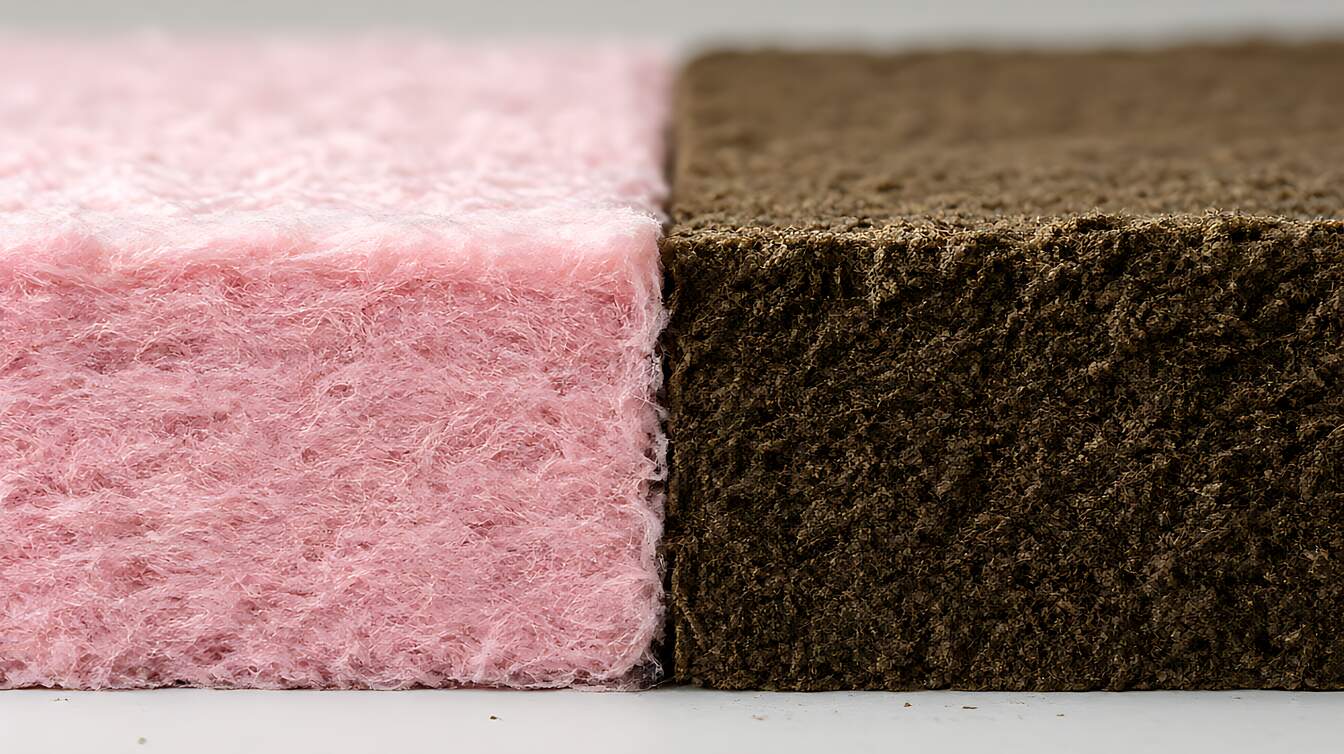
Fiberglass insulation uses fine glass fibers in batts or loose-fill and delivers about R-2.2 to R-2.7 per inch in common forms. It is the familiar baseline for dry, accessible cavities, but it does not stop air movement by itself.
Cellulose is recycled paper fiber treated for fire resistance and blown into cavities, usually at roughly R-3.2 to R-3.8 per inch. It fills irregular spaces well and can reduce air movement when installed densely.
Spray foam is a two-part chemical that expands in place. Open-cell foam is about R-3.5 to R-3.7 per inch, while closed-cell foam is about R-6 to R-7 per inch. It can act as both insulation and air barrier when applied correctly.
The direct answer is conditional. Choose fiberglass when the cavity is dry, accessible, and budget matters most. Choose cellulose when you want dense fill in an existing wall or attic and can keep bulk water out. Choose spray foam when air sealing is the main problem and the higher cost fits the project. For below-grade walls, compare this with basement insulation with rigid foam or mineral wool, because ground moisture changes the material ranking.
The Differences That Matter (Side-by-Side Table)
The criteria that change the answer are R-value per inch, air sealing, moisture behavior, installation access, and cost. Comparing the same five criteria keeps the choice honest, because a cheaper material can become expensive if it leaves air leaks or moisture problems untouched.
| Material | Typical R-value per inch | Air sealing | Moisture behavior | Best fit |
|---|---|---|---|---|
| Fiberglass batts or loose-fill | About R-2.2 to R-2.7 | Poor unless an air barrier is added | Can hold water; may dry if wetting is minor | Dry, accessible cavities |
| Cellulose, blown-in | About R-3.2 to R-3.8 | Moderate dense fill | Absorbs some moisture; needs bulk-water control | Existing walls and attics |
| Open-cell spray foam | About R-3.5 to R-3.7 | Good | Absorbs water; not for wet areas | Interior air sealing |
| Closed-cell spray foam | About R-6 to R-7 | Excellent | Resists water; can trap moisture if substrate is wet | Thin cavities and rim joists |
Those ranges are typical published values, not guarantees for your cavity. Real performance depends on installation quality, cavity depth, compression, and whether the material is continuous. An attached garage raises the same R-value and barrier questions, so review garage insulation and R-value barriers before treating the garage wall as ordinary interior space.
Which One to Choose for Your Situation
Match the material to the limiting condition, not to the marketing claim. A damp basement, a sun-exposed roof deck, a tight budget, and a storage-heavy attic floor each point to a different answer.
Choose fiberglass when the space is dry, the framing is regular, and cost is the main constraint. It is easy to install in open attics and easy to remove later for wiring or plumbing changes.
Choose cellulose when you are filling existing wall cavities or an attic floor and want dense fill around obstructions. It performs well when bulk water is controlled, but it is a poor choice for a wet area.
Choose spray foam when air leakage dominates the problem, such as rim joists, knee walls, or a roof deck with limited depth. Closed-cell foam adds moisture resistance; open-cell foam costs less but absorbs water.
When Each Option Stops Performing
The failure mode matters as much as the R-value, because a material that looks good on paper can underperform in the wrong cavity.
- Fiberglass loses real performance when air moves through and around batts; it is not an air barrier.
- Cellulose can settle if cavities are under-filled, and wet cellulose loses loft if bulk water persists.
- Open-cell foam absorbs water and can stay wet after a roof or plumbing leak.
- Closed-cell foam can hide moisture in the substrate and is difficult to remove for future repairs.
Real Job-Site Reality
On a real job site, the material is only half the result. Air gaps at top plates, compressed batts around wires, wet sheathing, and skipped baffles often matter more than the product name on the bag.
Picture a 1970s attic with recessed lights, ductwork, and a bathroom exhaust that vents into the space. Fiberglass laid around obstacles leaves thin spots. Blown cellulose fills gaps better but still needs baffles and a dry roof. Spray foam seals the air path, yet it can trap moisture if the roof deck already has a leak.
Common Job-Site Traps
The traps are predictable, which makes them avoidable before the material goes in.
- Insulating before air sealing leaves the biggest leaks untouched.
- Covering recessed lights without rated boxes creates a fire risk.
- Ignoring attic bypasses lets warm, moist air reach the roof deck.
If the house has moisture stains, musty odors, or peeling paint, fix water first. A home waterproofing inspection checklist can help separate a roof or plumbing leak from an insulation problem.
Fiberglass vs Cellulose vs Spray Foam Insulation: What Actually Matters
The long-term perbandingan is durability vs cost, and neither side wins in every house. Fiberglass is cheapest upfront and durable when dry. Cellulose costs more but fills irregular cavities well. Spray foam costs the most and can solve air leakage that other materials cannot.
Cost is not the only price. Spray foam can make future electrical or plumbing work harder. Cellulose can settle if installation depth is light. Fiberglass can leave thermal bridging at studs unless paired with continuous insulation.
Choose fiberglass if the cavity is dry, accessible, and the budget is tight. Choose cellulose if you want dense fill in an existing space with controlled moisture. Choose spray foam if air sealing or limited depth is the deciding problem, and the cost fits. For complex roofs, damp basements, or any sign of water intrusion, consult a professional before insulating. If budget is the deciding constraint, compare the full project scope with waterproofing cost and budget planning so insulation is not the only number in the decision.