
The monsoon came and went. Your laminate floor didn’t lie flat again.
That cupping along the hallway, the slight buckle near the balcony door — these aren’t cosmetic annoyances. They’re the HDF core telling you it’s been absorbing moisture faster than it can release it. In tropical and subtropical homes, this is the single most common failure mode in laminate flooring, and it almost always starts six months before anyone notices.
What Humidity Actually Does to a Laminate Plank
A laminate plank is not waterproof. Its HDF core (high-density fiberboard) is compressed wood fiber held together with resin. That resin limits moisture absorption but does not stop it.
When indoor relative humidity stays above 60% for weeks at a time, water vapor migrates into the plank through the most vulnerable point: the tongue-and-groove joint. These cut edges expose raw HDF that the factory wear layer does not protect. Moisture wicks in through the joint before it reaches the center of the plank.
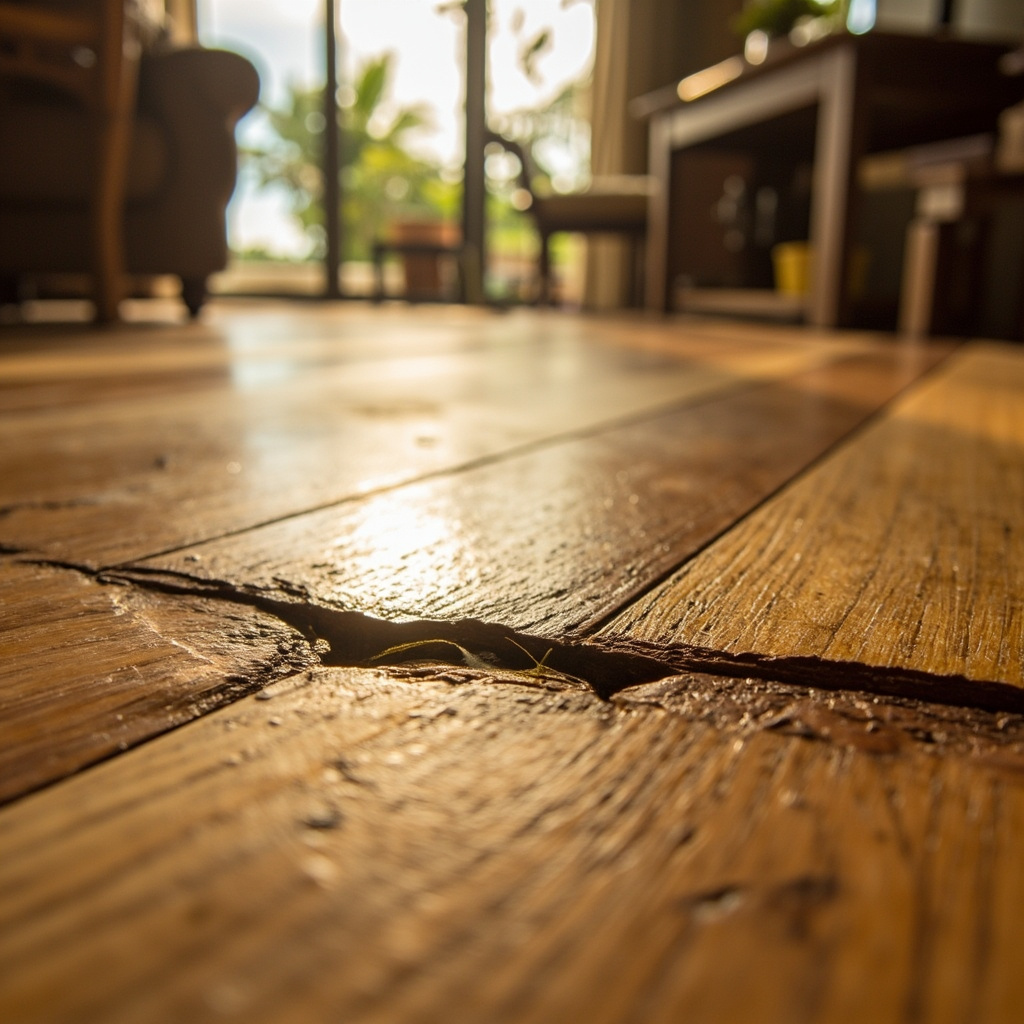
The edges swell first, which raises the profile of the tongue and groove and puts upward pressure on the plank. This produces the convex curve called cupping. In tropical installations, installers who skip edge sealing see failure at the seams 6–12 months before the field.
The expansion gap around the perimeter is meant to accommodate seasonal movement. But if the gap is too narrow or blocked by baseboard trim, the swollen planks have nowhere to go. The pressure builds until the floor buckles or the locking system snaps.
For homes built on a concrete slab, the problem compounds. Moisture vapor emission from the slab — even one that looks dry — can accumulate beneath the plank. Without a proper vapor barrier between slab and floating floor, that moisture rises into the HDF core from below, doubling the attack vector.
The Four Failure Symptoms: What Each One Means
Not every uneven floor is the same problem. The specific shape of the deformation tells you what has happened to the core and whether it can recover. Learning to read those shapes saves you from replacing a floor that still has years of service left — or from patching one that needs to come out entirely.
Cupping — The edges sit higher than the center, creating a shallow U-shape. This is the earliest visible sign. The plank edges have absorbed moisture and expanded while the center stayed dry. During dry season the cupping may flatten, but after 3–4 seasonal cycles the HDF loses its elastic memory and the deformation becomes permanent.
Crowning — The center sits higher than the edges, the reverse of cupping. This often follows a prior cupping event that was sanded flat before the edges fully dried. Sanding removes the high edges; when the planks rehydrate, the newly thin edges depress and the center appears to rise. Crowning always indicates a prior moisture problem that was misdiagnosed.
Buckling — One or more planks lift entirely off the subfloor, sometimes by 5–10 mm. This is a pressure event: the planks expanded until the locking system disengaged or the floor lifted as a whole.
Buckling typically starts at the longest run of continuous flooring with insufficient expansion gaps. If it has spread more than two planks from the wall, the installation may need reworking.
Gapping and edge swelling — Visible separation between planks, often accompanied by raised or chipped edges. Gapping occurs when the HDF core shrinks during dry periods after having swelled, leaving the planks undersized. Edge swelling appears as a rough, raised line along the tongue-and-groove seam where the core has expanded beyond the wear layer’s coverage.
In the field, the failure pattern that shows up most often isn’t a single catastrophic spill — it’s six months of 75% indoor humidity slowly fatiguing the HDF core until the planks stop lying flat. By the time the homeowner notices the cupping, the core has already taken permanent set.
The Humidity Thresholds That Trigger Failure
Laminate manufacturers test their products under controlled laboratory conditions. Most specify a safe operating range of 30–50% relative humidity, with an absolute upper limit of 60% for sustained exposure. Above that threshold, the HDF core begins to absorb moisture at a rate that exceeds its design tolerance, and the clock starts ticking on structural fatigue.
In coastal cities such as Surabaya, Makassar, or Singapore, indoor humidity during monsoon routinely sits at 75–85%. That 15–25 point gap above the warranty threshold is where most failures start — not from a single flood, but from sustained exposure the core was never designed to handle.
A moisture meter (pin-type) can measure moisture content inside the plank. For laminate, readings above 8% in the core are a red flag. Above 12% indicates active swelling that will soon produce visible symptoms.
For installations over a concrete slab, the subfloor moisture level matters even more. A calcium chloride test (ASTM F1869) measures vapor emission rate. Readings above 3 lb per 1,000 sq ft in 24 hours require a vapor barrier before any floating floor is laid.
Many rolled laminate products include an attached foam underlayment with a built-in vapor barrier. Older installations or those laid directly over slab without one are vulnerable from below — moisture rises into the HDF core continuously, not just during spills.
If you live in a climate where indoor humidity exceeds 60% for more than three months of the year, your laminate floor is at risk even if it was correctly installed. The real fix is choosing a flooring product rated for the conditions you actually have — not the conditions the warranty assumes.
When You Can Fix It vs When to Call a Professional
Not every humidity-damaged floor needs replacement. The decision comes down to three factors: area affected, subfloor condition, and cause of the moisture.
Spot repair works when three conditions are met: the visible damage covers less than ~10% of the floor area, the subfloor is dry, and the cause is a localised event — a spill that wasn’t dried, a pipe leak, or a broken seal near a door.
Individual planks can be cut out and replaced using a board replacement kit. Most flooring retailers stock the same product line for two to three years, so identifying the exact plank is often possible.
Call a professional when the failure covers more than 10% of the area, the cupping or buckling involves more than two rows of planks, or the subfloor itself shows signs of moisture (efflorescence, damp odour, high meter readings). A licensed contractor should perform a professional moisture assessment that includes slab testing, relative humidity logging, and a determination of whether the vapor barrier was adequate.
If the installation used insufficient expansion gaps — less than 8–10 mm per 10 m of run — the floor may need to be relayed with proper perimeter spacing. That is not a weekend DIY task; it requires pulling baseboards, cutting planks, and resetting the floating floor.
In some cases, a full floor replacement with a moisture-rated product is the more economical long-term decision. Rigid-core SPC and click-lock LVP both handle humidity that would destroy a standard HDF laminate within two seasons.
Warranty claims are rarely straightforward for humidity damage. Most laminate warranties exclude damage caused by environmental moisture above the specified humidity range. If the subfloor had no vapor barrier, the manufacturer will classify it as installation error.
Before replacing anything, review your warranty terms and measure your indoor humidity with a hygrometer. A month of logged readings at 70%+ tells you whether the problem is the product or the environment — and whether a different flooring category is the real fix.
For guidance on the correct installation procedure that avoids these problems from the start, see our detailed walkthrough on installing laminate on concrete the right way. If you are already researching alternative flooring for damp areas, our guide on comparing flooring materials for kitchens covers water-resistant options. For areas consistently above 70% humidity, consider HPL as a moisture-resistant alternative for vertical surfaces.