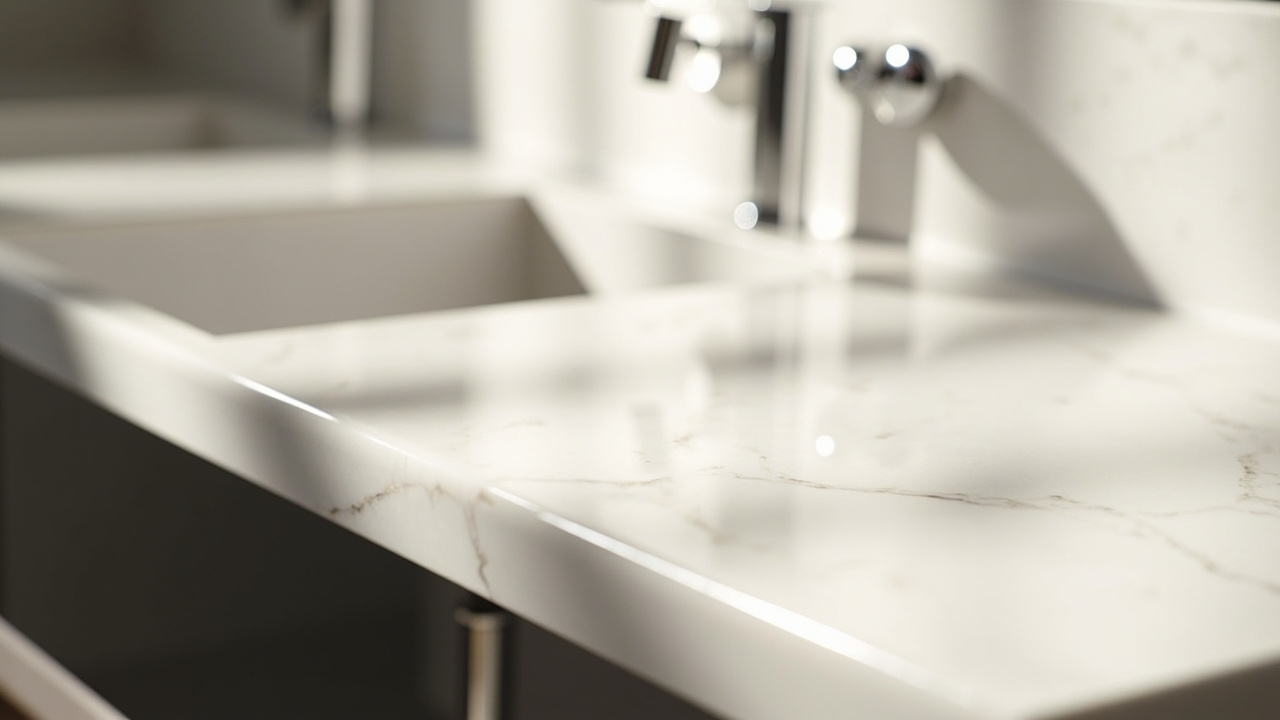

Choosing a countertop material is the decision most homeowners get wrong — not because the materials are bad, but because the surface looks identical from across the room and only fails at the seam, the sink cutout, or the first hot pan.
Granite, quartz, solid surface, and laminate are not just price tiers. Each one handles heat, stains, scratches, and seams differently — and the right choice depends on how the kitchen is actually used day to day.
This page walks the four main countertop materials side by side, with the real durability numbers, the maintenance trade-offs, and the situations where each one earns its price — or doesn’t.
What a Countertop Actually Has to Do
The benchtop surface gets all the attention, but the real engineering happens at the edges. A countertop has to bridge the gap between cabinet boxes, seal against the wall, and survive years of wet, hot, and sharp contact without failing at the joins.
The substrate — usually MDF, particleboard, or plywood — carries the slab and transfers load to the cabinet carcass. If the substrate is too thin or the wrong grade, the benchtop deflects under weight and cracks the surface at the cooktop cutout within a few years.
Edge profile matters more than most homeowners expect. A square edge chips on impact; a bullnose rolls the force; an ogee looks refined but collects dust in the curve. The edge is also where the seam meets the air — a poorly-finished edge at a seam opens up and lets water reach the substrate.
The undermount sink cutout is the most vulnerable point on the whole benchtop. The edge is exposed, the corner radii concentrate stress, and any water that sits there wicks into whatever substrate or stone lies underneath. The same applies to the cooktop cutout, where thermal cycling pushes and pulls the material every time the cooktop heats and cools.
The splashback join — where the benchtop meets the wall — needs a proper silicone seal, not a bead of grout. Grout cracks with benchtop movement; silicone flexes. Most failures at the back wall are seal failures, not material failures.
Granite — Natural Stone, Heat-Tolerant, but Porous
Granite is natural igneous stone, cut from quarried blocks and polished to a high gloss. It handles direct heat better than any other residential countertop — a hot pan from the oven won’t scorch it. That’s the selling point, and it’s real.
The problem is porosity. Granite absorbs liquid through microscopic pores in the stone. Red wine, coffee, cooking oil — if they sit on the surface for more than a few minutes, they stain. The fix is a penetrating sealer applied at installation and reapplied roughly every 12 months in a kitchen that sees daily use.
In the field, the failures homeowners complain about aren’t the surface — they’re the seams, the cutouts, and the edges where water sits. Choosing material based on the surface alone is how people end up with a stunning benchtop that fails at the sink cutout in year four.
Seam visibility is higher in granite than in manufactured stone. Each slab has unique veining, and matching two slabs so the seam disappears is almost impossible. A skilled fabricator can get the colour close, but the pattern break is usually visible from arm’s length.
The veining pattern is natural variation — no two slabs are identical. That’s part of the appeal, but it also means the sample on the showroom floor won’t match the slab that arrives. Homeowners who expect an exact match to a 100 mm sample are disappointed when the full slab has a different rhythm.
Granite earns its place in a heavy-cooking kitchen where hot pans land on the bench daily and the homeowner is willing to reseal annually. Skip the sealing frequency schedule and the stone darkens around the sink within two years — and that staining is permanent.
Quartz (Engineered Stone) — Consistent, Low-Maintenance, but Heat-Sensitive
Quartz countertops are engineered stone — roughly 90% crushed quartz bound with a resin binder and pigment. The result is a non-porous surface that needs zero sealing. Wine, coffee, lemon juice — they sit on the surface without penetrating, and wipe off with a damp cloth.
The consistency is manufactured, not natural. The consistent pattern repeats across slabs, so what you see in the showroom is what you get. That predictability matters in large kitchens where three or four slabs need to look like one continuous surface.
But the resin binder has a weakness: heat sensitivity. Most quartz binders scorch at temperatures above 150°C. A hot pan straight from the oven, a slow cooker that vents steam onto the bench, a forgotten iron — any of these leaves a permanent scorch mark that can’t be sanded out. Use a trivet, and the problem disappears. Don’t, and the damage is done.
Quartz’s reputation as indestructible is half true. It handles stains, scratches, and daily wear better than granite — but a hot pan straight from the oven leaves a permanent scorch mark on the resin binder. The fix is trivial (use a trivet), but most homeowners don’t know until the damage is done.
Seam visibility in quartz is tighter than in granite. A skilled fabricator can get a near-invisible join, especially in lighter colours and consistent patterns. In darker quartz with heavy veining, the seam still shows, but less dramatically than natural stone.
Brand transparency matters here. Caesarstone, Silestone, Quantum Quartz, and YDL Stone all produce quartz, but the resin quality, UV stability, and colour consistency vary between them. A quote that says “quartz benchtop” without a brand and product code is a red flag — the fabricator could install a budget import that yellows in sunlight within three years.
Solid Surface — Seamless, Repairable, but Soft
Solid surface is acrylic or polyester-based material — brands like Corian, Staron, and Hi-Macs dominate the market. The defining feature is the seamless join: sections are chemically welded together with adhesive that bonds at the molecular level, creating a joint that’s virtually invisible once sanded and polished.
That seamless quality enables the integrated sink — a basin moulded directly into the benchtop with no lip, no seam, and nowhere for water to collect. In practice, this means no mouldy silicone ring around the sink, no grime trap, no joint to fail. It’s the reason hospitals and laboratories use solid surface for their benchtops.
The other advantage is scratch repairability. Solid surface is the only countertop where a scratch or scorch can be sanded out and refinished on site — no slab replacement, no visible patch. A fine-grit sandpaper and a pass with a scotch-brite pad removes surface scratches; deeper cuts get filled with matching compound and sanded flush.
The trade-off is hardness. Solid surface is softer than stone, so daily knife work leaves marks that need annual resurfacing. In a busy kitchen, the matte finish shows wear patterns around the sink and prep areas within the first year. That wear is repairable, but it’s maintenance that granite and quartz don’t require.
Heat sensitivity is lower than quartz. A hot pan on solid surface will mark it at a lower temperature than quartz marks, and the mark is often deeper. Trivets are non-negotiable with this material.
Laminate — Affordable, Improved, but Limited Lifespan
Laminate countertops consist of an HPL (high-pressure laminate) surface bonded to an MDF or particleboard substrate. The post-formed edge — a rolled front edge with no visible seam at the front face — is the standard profile, and it eliminates the join line where the top meets the edge.
Laminate’s quality has jumped in the last decade — the best post-formed benchtops look like stone at a distance. The pattern variety is virtually unlimited: printed woodgrain, marble looks, concrete effects, solid colours. If you can print it, a laminate mill can press it.
The failure mode is the substrate edge. Water that wicks under the laminate at the sink cutout causes the MDF to swell, and once swelling starts the only fix is full replacement. The exposed cutout edges — around the sink, at the cooktop, at any joint — must be sealed perfectly during fabrication. Even then, years of thermal cycling and water exposure eventually defeat the seal.
Heat resistance is limited. A hot pan damages the HPL surface, and the damage is permanent — no sanding, no refinishing, no fix. Trivets are mandatory, not optional.
In a family kitchen with kids, laminate handles stains well (the surface is non-porous) and takes moderate wear. But the expected lifespan is 10–15 years in a kitchen that sees daily use, compared to 20–30 years for stone. Homeowners who plan to stay in the house long-term often find the replacement cycle frustrating; those renovating for resale or planning a kitchen update within a decade find the value compelling.
Cost, Lifespan, and Heat/Stain Comparison Table
The right comparison between granite at AUD 350/m² installed and quartz at AUD 500/m² is not the upfront cost — it’s the cost over 20 years when the granite has been resealed four times and the quartz needs no maintenance at all.
| Factor | Granite | Quartz | Solid Surface | Laminate |
|---|---|---|---|---|
| Material + install cost per m² | AUD 300–450 | AUD 400–600 | AUD 350–550 | AUD 100–250 |
| Expected lifespan | 25–30 years | 20–25 years | 15–20 years | 10–15 years |
| Heat resistance | Excellent (direct heat OK) | Poor (scorches above 150°C) | Poor (marks at low heat) | Poor (permanent damage) |
| Stain resistance | Moderate (needs sealing) | Excellent (non-porous) | Good (non-porous) | Good (non-porous) |
| Seam visibility | High (visible) | Low (near-invisible) | Very low (chemically welded) | Moderate (post-formed) |
| Annual maintenance | Sealing every 12 months | None | Occasional refinishing | None |
| Repairability | Limited (spot repair) | Limited (panel replacement) | High (sand and refinish) | None (full replacement) |
Choosing Material by Cooking Style
The choice is shaped by how the kitchen is actually used, not how it looks on day one.
In a heavy-cooking household where hot pans hit the bench daily, granite outperforms quartz because the surface tolerates thermal shock. A slow cooker, a stockpot straight from the stove, a forgotten iron — granite shrugs these off. Quartz, in the same scenario, will scorch.
In a light-cooking household that values stain-free consistency, quartz wins on maintenance. Cold prep, oven-dominant cooking, the occasional warm pot on a trivet — quartz stays pristine with nothing more than a wipe-down. No sealing, no refinishing, no annual maintenance bill.
For a baking-focused household that rolls pastry on a cool surface, solid surface and laminate both work. Solid surface gives a smooth, cool, seamless expanse that’s kind to pastry dough. Laminate gives the same cool surface at a fraction of the price, though the seam at the front edge can leave a faint line in thin dough.
A family with kids faces stain risk (spaghetti sauce, juice boxes, texta marks) and durability concerns (dropped pots, climbing on benches). Quartz handles both well — the surface is non-porous and scratch-resistant. Laminate handles stains but shows wear faster. Granite handles durability but needs sealing to resist stains.
An entertainer with a large island wants the visible surface area to read as one continuous piece. Quartz and solid surface both deliver here: quartz for consistency across slabs, solid surface for the chemically-welded seam that disappears entirely.
In the field, the heavy-cooking household that chooses quartz ends up replacing one or two scorched panels within five years — and the manufacturer warranty almost never covers thermal damage from cookware.
For a detailed look at how countertop choice fits into the wider project budget, see the kitchen renovation cost breakdown.
When to Mix Materials and What to Specify in Writing
The most cost-effective kitchen is usually a hybrid: quartz on the island (visible, low-maintenance) and laminate on the perimeter (hidden under wall cabinets, hidden from guests). The mixed-material kitchen approach lets the homeowner spend where it shows and save where it doesn’t.
What the homeowner must lock in writing is the seam placement planning. Fabricators default to wherever is structurally easiest — usually the shortest slab run — not wherever is visually least noticeable. A seam across the middle of an island benchtop is a permanent eyesore; a seam tucked at the far end of a perimeter run is invisible.
The fabricator specification sheet should nominate the brand and product code: Caesarstone 5141, not just “quartz”; Corian Glacier White, not just “solid surface”. Without a product code, the fabricator can substitute a lower-tier product and the homeowner won’t know until it’s installed.
Slab thickness matters. A 20 mm slab looks thin next to 30 mm on the adjacent run. Specify the thickness in the quote — and confirm whether the quoted price includes the thicker slab or upsells it.
Warranty terms need close reading. Material warranties (10–15 years from the brand) cover manufacturing defects — delamination, colour inconsistency, structural failure. Fabrication warranties (1–2 years from the installer) cover seam failure, cutout cracking, and edge chipping. They’re separate warranties from separate parties, and both need to be in writing before the deposit.
The undermount sink compatibility detail is the most common leak point. Fabricators default to a drop-in cutout unless the undermount detail is specified in writing — and a poorly-fabricated undermount cutout leaves a lip where water pools and eventually leaks into the cabinet below.
For what sits underneath the benchtop, see the cabinet materials guide. For the spec errors that show up in warranty claims, see the common countertop mistakes.