
The cooking smell that lingers for hours after dinner isn’t just a nuisance — it’s a signal that the kitchen is trapping heat, steam, and grease particles that settle on every surface and slowly degrade the cabinetry and paint.
Rangehood, exhaust fan, and natural ventilation are not just price tiers. Each one moves air differently, and the right match depends on where the kitchen sits in the building, how the household cooks, and whether the structure allows ducting to the outside.
This page explains the three main ventilation approaches side by side, with their real airflow capacity, their honest limits, and the kitchen layout where each one earns its place.
Why Kitchen Ventilation Is Not Optional
A kitchen without planned ventilation doesn’t just smell — it accumulates. Every time the cooktop runs, it releases heat, steam, and airborne grease particles that migrate across the room and settle on cabinetry, ceiling paint, and inside cupboards. Over months, that film traps dust and creates a sticky layer that ordinary cleaning won’t shift.
The mechanism is straightforward: hot air and moisture rise from the cooktop, hit the ceiling, cool, and condense. That condensation soaks into paint and plaster, and in humid climates — Sydney, Brisbane, anywhere subtropical — mould follows within one to two wet seasons. The homeowner repaints every 18 months without ever addressing the cause.
What matters is that ventilation isn’t about comfort alone. Chronic moisture degrades cabinetry joints, swells MDF kickboards, and corrodes shelf brackets inside closed cabinets where the damage stays hidden until the door hinge pulls out. A kitchen that vents properly protects the joinery investment as much as it clears the air.
Rangehood — Most Effective, but Needs Ducting
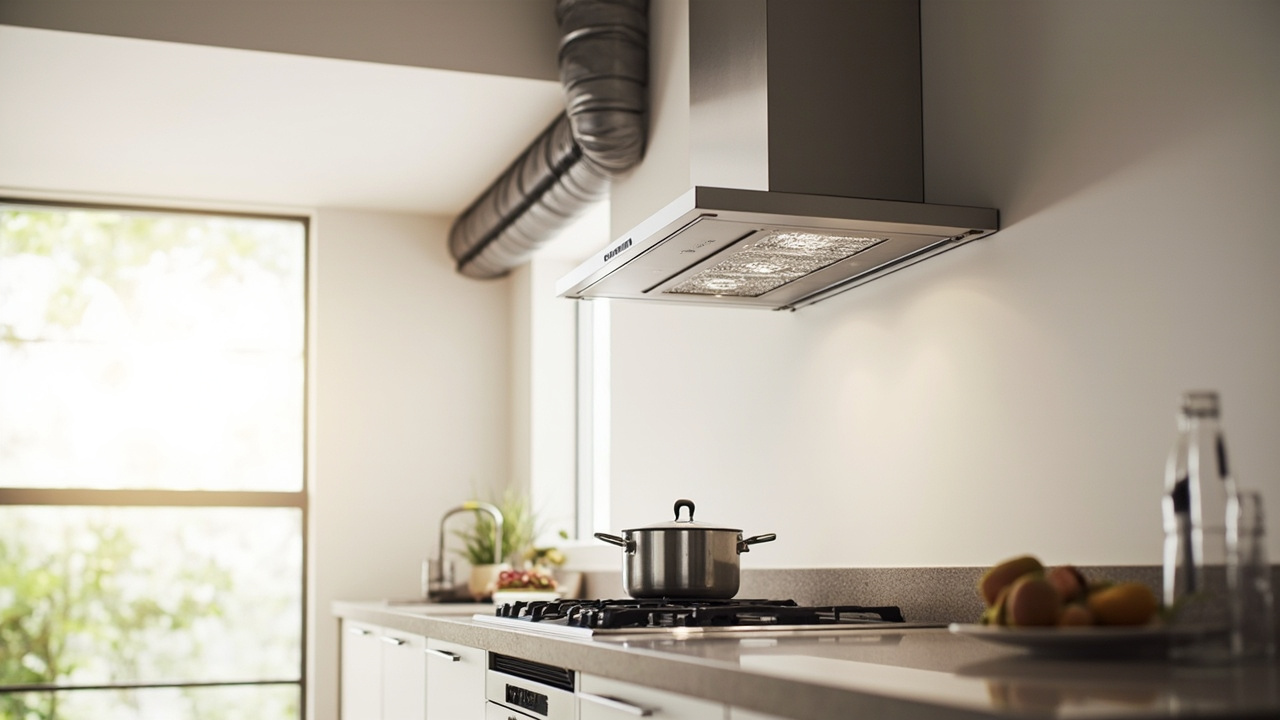
A rangehood captures steam and grease at the source — directly above the cooktop — before it disperses into the room. That proximity is what makes it the most effective option for households that cook daily, especially with gas cooktops that produce combustion by-products as well as heat and moisture.
The airflow capacity is measured in CFM (cubic feet per minute) or m³/h, and the rating needs to match the cooktop width and the kitchen volume. A typical 90 cm gas cooktop needs a hood rated at 600–900 CFM minimum to capture the plume effectively. Undersized hoods don’t fail dramatically — they just let the edges of the steam cloud escape into the room while the motor runs at full speed.
The critical distinction is ducted versus recirculating. A ducted rangehood pushes air through ducting to the outside, removing heat, moisture, and odour entirely. A recirculating hood passes air through a grease filter and a charcoal filter, then releases it back into the kitchen — fine for light cooking, but it does nothing for moisture or heat. The honest trade-off: recirculating hoods are easier to install but they don’t solve the condensation problem.
The rangehood that fails most often isn’t the motor — it’s the ducting. Flexible duct with too many bends loses roughly half its airflow, and the homeowner wonders why the hood is loud but the kitchen still smells. Rigid duct with no more than two 90-degree bends performs as rated, but most installers skip it because it’s harder to fit through ceiling cavities. Specify the ducting material and bend count in the quote, not just the hood model.
Island-mount rangehoods add another constraint: no adjacent wall means the ducting has to run through the ceiling cavity to the nearest external wall or ridge vent. That longer run demands a higher CFM rating to compensate for friction loss, and the hood itself needs structural support — a 40 kg island hood screws into the ceiling joist or a purpose-built brace, not just the plasterboard.
Exhaust Fan — Cheaper, Simpler, but Less Targeted
An exhaust fan pulls air from the kitchen and pushes it outside through a wall or ceiling penetration. The installation is simpler than a rangehood — no ducting run across the ceiling, no mounting above the cooktop — and the unit cost is lower. For a rental property or a kitchen with light cooking habits, that simplicity is the main selling point.
The limitation is targeting. A rangehood captures steam at the cooktop; an exhaust fan pulls air from the room generally. That means it also pulls cool air from the air-conditioning, which is why a kitchen with an exhaust fan and AC never quite works — the fan removes the cooled air faster than the AC can replace it. The room feels stuffy, the AC runs longer, and the energy bill climbs.
Airflow capacity still matters. A typical wall-mount exhaust fan for a small to medium kitchen runs 200–400 CFM, which clears general odour over 10–15 minutes but won’t capture a vigorous boil-off at the cooktop. The backdraft damper is the component most often omitted in budget installs — without it, outside air pushes back through the fan when it’s off, bringing dust, insects, and cold drafts in winter.
Noise level, measured in dB at max speed, is the spec most homeowners ignore until the fan is running. A unit rated above 60 dB at high speed dominates the kitchen conversation. For open-plan living where the kitchen flows into the dining area, look for a fan rated 45 dB or below at its highest setting — the trade-off is usually lower airflow, so check the CFM rating hasn’t dropped below what the room needs.
Natural Ventilation — Free, Silent, but Weather-Dependent
Natural ventilation uses openings — windows, doors, passive stack vents — to move air through the kitchen without any mechanical assistance. When it works, it’s free, silent, and effective. The catch is that it only works when the conditions cooperate.
Cross-flow ventilation is the most reliable form: two openings on opposite walls create a path for air to move through the room. A sash window that adjusts the opening height gives some control over airflow speed. In a subtropical climate with regular afternoon breezes, a kitchen with two well-placed windows clears steam within minutes of cooking finishing.
The honest limitation is stillness. On a hot, humid afternoon with no wind — exactly the conditions when the kitchen produces the most steam — natural ventilation does almost nothing. The warm air sits in the room, condensation forms on the coolest surfaces, and the homeowner opens the window wider without result. Natural ventilation is a supplement, not a primary strategy, for any household that cooks daily.
There’s also a security consideration. An open window while cooking means an open window while the cook is distracted, and on ground-floor or easily accessible installations that’s a real concern. Passive stack ventilation — a vertical duct that uses warm air rising to draw air out at ceiling level — avoids the open-window problem but requires roof penetration and works best when there’s a temperature difference between inside and outside.
Matching Ventilation to Kitchen Layout
The layout of the kitchen decides the ventilation, not the other way around. A galley kitchen with one external wall has a straightforward path: rangehood above the cooktop, short duct run straight through the wall or into the ceiling cavity. That short run means the hood performs close to its rated CFM, and installation cost stays low.
An L-shaped kitchen usually has a corner wall available for the rangehood, which keeps the ducting short and the efficiency high. A U-shaped kitchen offers multiple wall options, but the cooktop placement determines which wall works — the hood has to sit directly above the cooktop, so the ducting path follows the cooktop, not the most convenient wall.
The island kitchen is where the decision gets expensive. No wall behind the cooktop means two options: an island-mount rangehood hanging from the ceiling (effective, but heavy and needs structural support plus a long duct run through the ceiling cavity) or a ceiling-mount exhaust fan positioned near the cooktop (cheaper, less targeted, shorter duct run). The layout and the ceiling cavity depth usually make the decision for the homeowner.
In the field, the island kitchen that tries to run a standard wall-mount rangehood ends up with a 6-metre flexible duct run across the ceiling — and loses two-thirds of the airflow before it even reaches the outside wall.
Open-plan living adds noise to the equation. A rangehood rated above 65 dB at max speed dominates the dining area, so the spec has to balance airflow against noise — and that often means a larger hood running at a lower speed rather than a small hood screaming at high speed. For the geometry of each layout type and how ducting paths change, see the kitchen layout types comparison.
What to Specify in Writing
The rangehood quote that just says “supply and install rangehood” is a red flag. Without the CFM rating, the ducting spec, the filter type, and the noise level in writing, the installer defaults to whatever is cheapest on the day — and the homeowner ends up with a recirculating hood ducted to nowhere.
Specify the CFM requirement matched to the cooktop width and kitchen volume. For a 90 cm gas cooktop, that’s 600–900 CFM minimum. Specify the ducting: rigid or flexible, diameter (150 mm minimum for most residential hoods), and maximum two 90-degree bends. Specify the filter type — metal mesh or baffle grease filter is mandatory, charcoal filter only if the hood is recirculating. Specify the noise level in dB at max speed, and confirm whether the warranty covers the motor only or the full unit including switches and electronics.
For island kitchens, confirm the hood weight and the ceiling structure. A 40 kg island hood needs a structural connection to the joists or a purpose-built brace — not a screw into the plasterboard. Get that in writing before the rough-in, because retrofitting structural support after the ceiling is lined costs more than the hood itself.
The spec errors that show up most often in warranty claims are undersized ducting, missing backdraft dampers, and recirculating hoods sold as ducted. For the full list of spec gaps and how they surface after handover, see the common ventilation mistakes article. For how ventilation costs sit inside the broader project budget, see the kitchen renovation cost breakdown.