
You’re choosing or supervising a kitchen countertop and the pro/con lists online aren’t enough. You need to know which material fits your cabinet, your stove heat, and your budget before the slab is cut.
Pick wrong and you get a cracked seam or a bowed cabinet; pick right and the surface outlasts the kitchen. This guide gives the tolerances, traps, and decision points that actually matter. Kitchen countertop materials are the finished horizontal work surfaces bonded to the cabinet box, typically 15-20mm thick, that must carry 50 lb per square foot without sagging.
The biggest mistake is treating quartz, granite, and laminate as interchangeable. They are not. Quartz is engineered stone; granite is natural stone; laminate is a resin surface over particleboard or plywood. Each needs different cabinet prep, seam placement, and heat care. Decide before the slab is cut, not after.
Kitchen Countertop Materials: What They Are and the Direct Answer
Kitchen countertop materials are the finished horizontal work surfaces bonded to the cabinet box, usually 15-20mm thick, that must carry a 50 lb per square foot load without sagging. Choose quartz for low maintenance, granite for natural veining, laminate when budget and weight both matter.
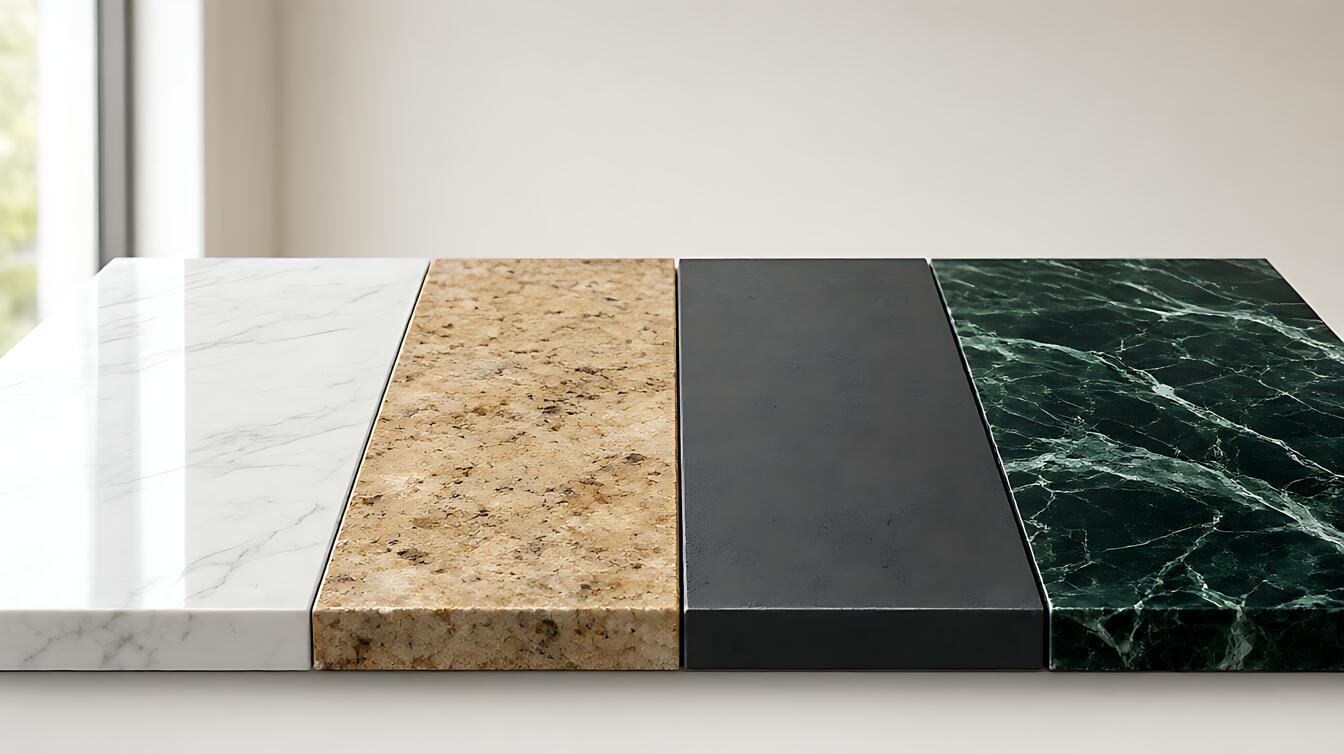
Quartz is engineered stone made from crushed quartz and resin; granite is natural stone cut from a slab; laminate is a thin resin-impregnated surface bonded to a wood or particleboard core. Each behaves differently under heat, moisture, and load, so the cabinet prep changes with the material.
A straight 2.4m run of laminate over a dry pantry is a different job from a 3x4m kitchen with a 60°C stove wall and a sink cutout. The material follows the room, not the other way around. For the full renovation scope, see the kitchen renovation guide.
| Material | Heat tolerance | Maintenance | Relative cost | Best for |
|---|---|---|---|---|
| Quartz | Moderate (scorches) | Low (no sealing) | Medium-high | Daily cooking, spills |
| Granite | High | Medium (seal yearly) | Medium-high | Heat, resale |
| Laminate | Low (burns) | Low (wipe clean) | Lowest | Dry, low-abuse surfaces |
What to Gather First: Tools and Materials for Countertop Work
Gather tools and materials before you measure: a 4-foot level, a moisture meter, silicone sealant rated for the seam, and a substrate of cabinet box plywood at 15-18mm. Verify the cabinet is level within 3mm over 2m before any slab arrives.
Check the substrate first. Plywood at 15-18mm holds a 50 lb per square foot countertop load when frames are at 400mm centers. Aluminum frames resist moisture but cost more and need different fasteners. Solid wood moves with humidity and can telegraph through a thin slab. Structure and substrate costs are covered in kitchen renovation materials and structure costs.
Gather these tools before the slab arrives; each one prevents a callback:
- 4-foot level for cabinet flatness
- Moisture meter for substrate and slab
- Silicone sealant for seams and sink rim
- Shims for leveling frames
- Clamps for seam alignment during cure
Step by Step: Installing Kitchen Countertop Materials With Tolerances
Install in this order: level the cabinet, dry-fit the slab, cut the sink opening with 4mm clearance, set the seam with silicone, and clamp for 24 hours. Re-check level after the adhesive cures, because a slab that shifts 2mm becomes a visible lip.
The process splits into five parts: cabinet prep, slab dry-fit, cutout, seam bonding, and cure. Each step decides the final result, and each has a tolerance you can actually check with a level and a tape measure.
- Level cabinet frames to within 2mm over 2m; shim and re-check.
- Dry-fit the slab with 3mm expansion gap at walls.
- Cut sink opening 4mm oversized; seal raw edges.
- Apply silicone at seam, align, clamp for 24 hours.
- Re-check level and seam after cure; adjust shims.
Seam placement matters more than seam width. A seam across a sink cutout or in front of a stove concentrates stress and opens first. Place seams over solid support, never over a void or a cabinet joint, and keep the overlap at 4 inches minimum where two slabs meet.
Re-check after cure. A slab that shifts 2mm during bonding becomes a visible lip at the seam and a trip hazard at the edge. If the seam opens or the surface rocks, stop and re-bond before grout or trim goes in.
Common Mistakes With Kitchen Countertop Materials
Common mistakes with kitchen countertop materials start with skipping the level check and end with a cracked seam. A slab set on an out-of-level cabinet twists under load; a seam placed over a void opens within months; a hot pan on laminate burns through in seconds.
- Skipping the moisture check on the substrate
- Placing a seam over a sink cutout or void
- Setting a hot pan directly on laminate
- Ignoring the 3mm expansion gap at walls
- Over-tightening clamps and bowing the slab
Humidity changes the answer. In a kitchen above a damp basement or next to an unvented dishwasher, plywood substrate swells and telegraphs through a thin slab. Seal cut edges, use a moisture barrier under the substrate, and pick quartz or granite over laminate where moisture is chronic.
Waterproofing around the sink is the second failure point. A silicone bead that gaps lets water reach the substrate, and swollen plywood lifts the slab from below. Tool the bead smooth, let it cure 24 hours, and re-inspect after the first week of use.
Kitchen Countertop Materials: Choosing Between Quartz, Granite, and Laminate
Choose quartz if you want low maintenance and consistent color, granite if you want natural variation and heat tolerance, laminate if budget and weight drive the decision. Call a pro for any seam over 4 inches, any sink cutout, or any substrate you cannot verify is level.
The downside is clear. Quartz resists stains but scorches under a hot pan. Granite tolerates heat but needs sealing and shows seams. Laminate costs least and weighs least but burns, swells, and telegraphs substrate flaws. Match the material to the abuse the surface will take, not to the showroom sample.
Choose quartz when the kitchen sees daily cooking and spills. Choose granite when heat tolerance and resale weight matter more than upkeep. Choose laminate for a dry, low-abuse surface or a rental refresh. When the cabinet is out of level or the substrate is unknown, hire a pro before the slab arrives.
Costs, labor, and structure details live on the kitchen countertop installation cost guide. For the mistakes that sink a project after install, read kitchen renovation mistakes before you sign a contract.