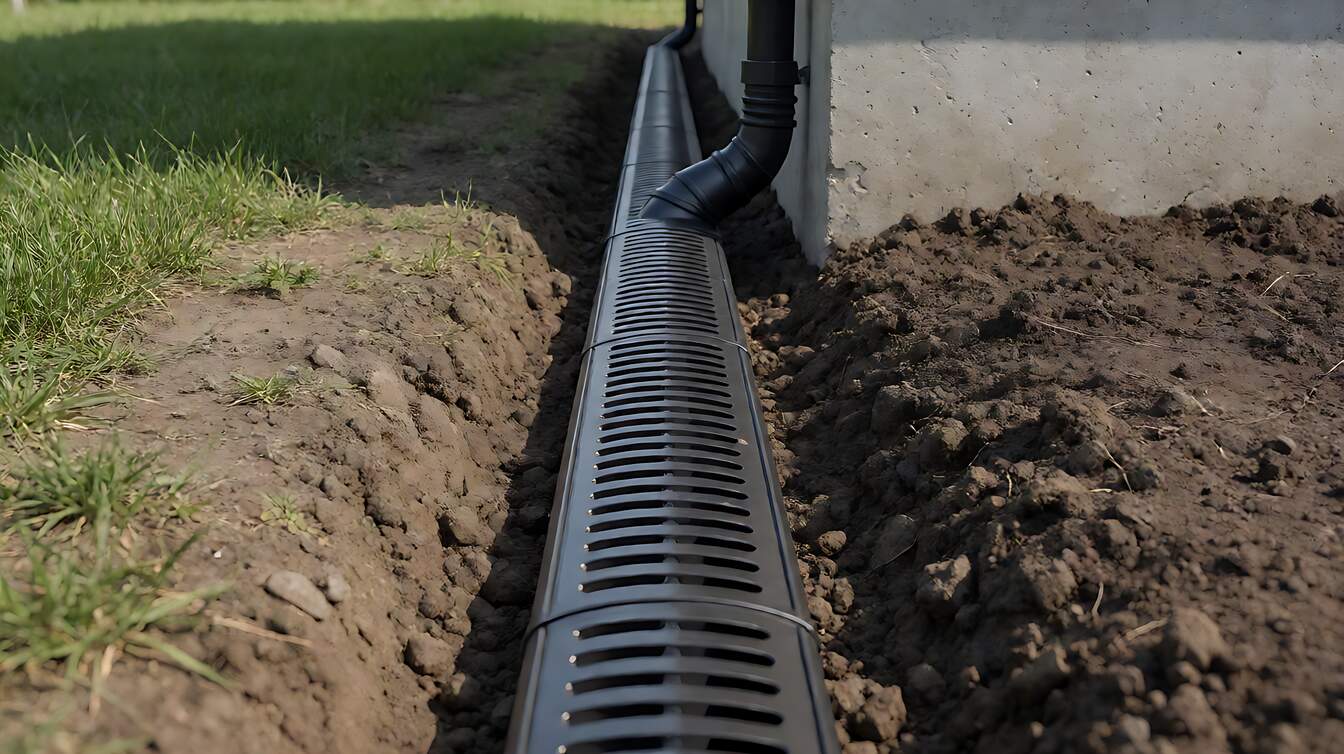

The frustrating part is seeing water collect behind a wall after every storm, then wondering whether the fix needs more gravel, a pipe, or a completely different approach. Wall drainage in heavy rain is a drainage assembly that moves water away from a wall before it builds pressure behind the face, using a stone reservoir, a perforated pipe, and a filter that keeps soil out. Choose the pipe and slope first, because those determine where the water goes.
Wall Drainage in Heavy Rain: A Pressure-Relief System, Not a Waterproof Layer
Wall drainage in heavy rain works by relieving water pressure behind a wall, keeping water moving instead of letting it push against the face. A common residential detail uses about 12 inches of clean drainage stone directly behind the wall, often paired with a 4-inch perforated pipe near the base.
Here is the distinction that matters: drainage does not stop rainfall from reaching the wall. It gives that water a controlled route away. When the system works, saturated soil drains toward the stone column and pipe rather than pressing outward against the masonry.
The trade-off is straightforward. A wall that looks dry after a storm may still have a clogged filter or a pipe discharging too close to the foundation. For the broader site picture, compare foundation drainage and French drain grading before assuming the wall detail is the only problem.
How Wall Drainage Handles Heavy Rain: Stone, Pipe, Filter, and Slope
The drainage stone reservoir typically measures 12 inches wide behind many residential walls, using clean 3/4-inch crushed stone or roughly 20 mm aggregate. That depth gives collected water space to move downward toward the 4-inch perforated pipe placed at the base.
The pipe handles the second half of the job. Perforations face downward, and the pipe runs at a 1% minimum slope toward daylight or a dry well. At a 1% slope, the pipe drops roughly 1 inch for every 8 feet of run.
The filter fabric ties the layers together. Without it, fine clay particles migrate into the stone and can clog the drainage stone within two years. Over a longer five to ten year period, that same migration can seriously reduce how freely the assembly drains.
Each component depends on the next. Stone without a pipe has nowhere useful to send water. Pipe without stone collects less water. Both without fabric eventually fill with soil. The drainage details also represent roughly 12% to 22% of wall cost, yet they strongly influence whether the wall lasts 30 years or fails in seven.
Choosing Wall Drainage Components for Heavy Rain Conditions
The right choice depends on soil behavior, available discharge space, and how much you can protect the installation. Use the comparison below to match each component with the condition it handles best.
| Component | Use it when | Key specification | Watch for |
|---|---|---|---|
| Drainage stone | Soil presses against the wall in heavy rain | 12 in depth, clean 3/4 in crushed stone | Soil contamination without a filter |
| Perforated pipe | Collected water needs a reliable exit | 4 in pipe, 1% minimum slope | No daylight or dry well available |
| Filter fabric | The surrounding soil contains fine clay | Separates soil from drainage stone | Tears or gaps during backfill |
| Weep holes | Small amounts of water must pass through the face | Placed at low points in the wall | Blocked outlets |
Choose a perforated pipe when the wall holds back substantial soil and water pressure. Choose weep holes when the wall face can safely release smaller amounts of water, and verify that every outlet discharges somewhere useful. More details on retaining wall construction and drainage help clarify how these layers fit the wall assembly.
Real Job-Site Conditions: Where Wall Drainage Fails
A common site symptom is a damp patch along the lower part of a wall after a storm, paired with a new pile of wet soil near the base. That pattern often points to the assembly working partly, with water collecting but leaving slowly, rather than a completely absent drainage system.
The process starts with excavation and inspection. A contractor exposes the wall base, checks whether a 4-inch drain pipe exists, and confirms that the perforations face downward. Next, the pipe slope gets checked toward its discharge point. Then the stone and filter fabric go in around the pipe.
- Expose the wall base to verify whether drainage stone, filter fabric, and a perforated pipe are present.
- Check the pipe slope, ensuring it falls at least 1% toward daylight or a dry well.
- Confirm the perforations face downward so entering water can reach the pipe.
- Protect the drainage stone with properly connected filter fabric during backfill.
- Keep discharge water away from nearby foundations to prevent transferring the problem.
Two traps recur. Missing fabric lets clay soil clog the stone within two years. A pipe without a confirmed outlet can simply move the problem several feet away. If cracks accompany the wet area, distinguish drainage from structural failure before choosing materials, with foundation crack injection and repair covering that separate concern.
Limits, Trade-Offs, and Your Next Step
Wall drainage has clear limits. It depends on stable soil, an open discharge route, and a filter that stays intact. It cannot compensate for a wall built beyond its capacity, and it cannot replace proper surface grading around the structure.
The cost trade-off is real but revealing. Drainage accounts for roughly 12% to 22% of wall cost, and proper drainage strongly affects whether a retaining wall lasts about 40 years or fails in five. Cutting that share may appear attractive, yet the expense of removing and rebuilding a failing wall makes the omission expensive.
- Choose a full stone, pipe, and fabric assembly when the wall retains soil and faces repeated heavy rain.
- Choose simpler weep holes when water volume is limited and the wall face can release it safely.
- Choose repair work over replacement when the wall structure remains sound and only the drainage layer has clogged.
Before excavating, confirm that the drainage issue is not actually coming through the wall face or from the foundation below. Foundation types, including slab, crawl, and basement determine where excess water can travel next. Because excavation can affect structural support and waterproofing, consult a qualified professional before disturbing the wall base or choosing a material variant.