
What kind of kitchen sink faucet is right for your space? The answer isn’t “the most expensive one”, it’s the one whose type, spout height, handle style, and finish match the way you actually use your sink every day. A pull-down spray head changes dishwashing entirely. A low-arc model might be all you can fit under a window sill. The wrong finish shows water spots within days. Get these basics right once, and the fixture serves you for ten to fifteen years.
Faucet Type, Pull-Down vs Pull-Out vs Bridge vs Wall-Mounted
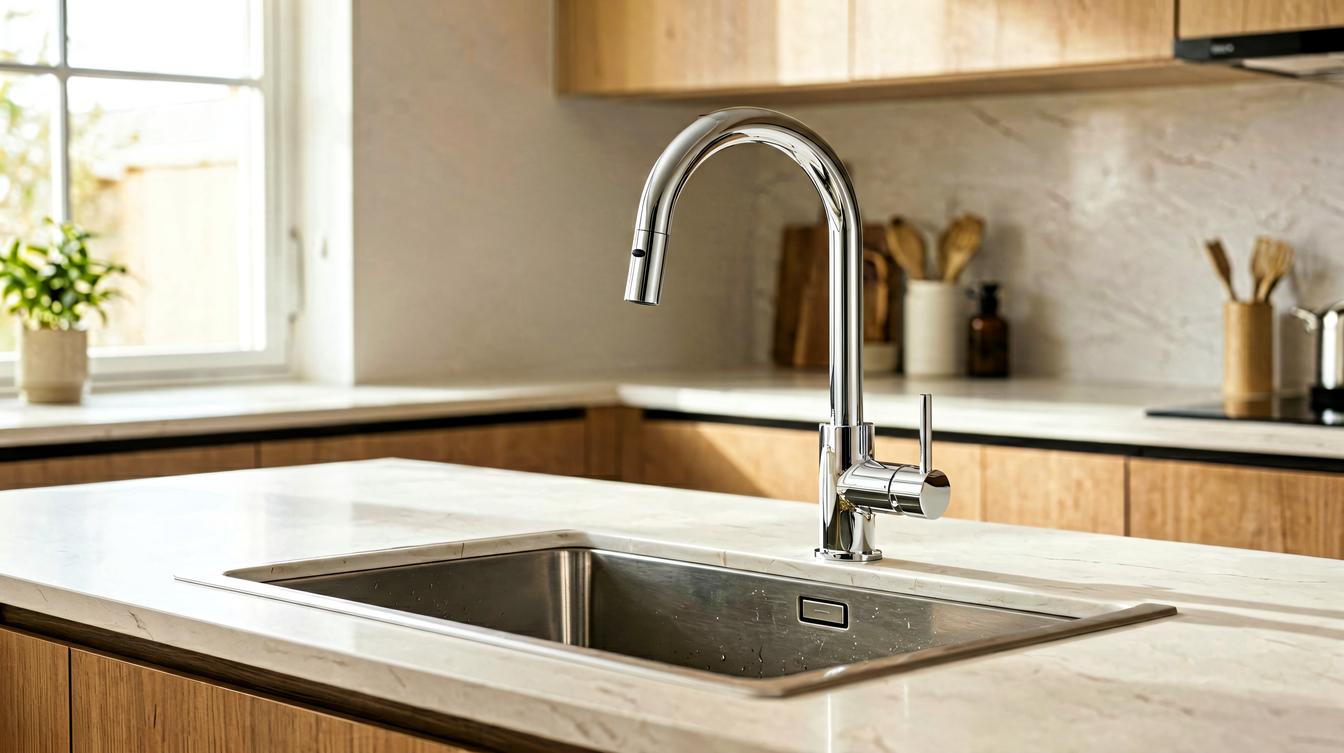
The type determines how the spray head moves, how high it clears your sink, and what sink layout it fits. Pull-down faucets dominate new installations because their high-arc spout and downward-pulling spray head handle everything from rinsing vegetables to filling a 4-quart stockpot. The spray head retracts into the spout on a spring-loaded hose and docks magnetically on most mid-range and premium models, so it never droops or swings loose.
Pull-out faucets sit lower and pull the spray head outward toward you instead of down. Their profile is shorter, usually 8 to 12 inches tall, so they clear low windowsills and overhead cabinets where a pull-down wouldn’t fit. The trade-off is less vertical reach inside the sink, which matters if your basin is deeper than 8 inches or if you regularly wash sheet pans standing upright. Pull-out wands also have a longer horizontal reach, which helps in double-bowl sinks where one side is often used for prep.
| Type | Best For | Spout Height | Hole Count |
|---|---|---|---|
| Pull-down | Deep single-bowl sinks | 15-18 in | 1 (+ optional plate) |
| Pull-out | Shallow or divided sinks | 8-12 in | 1 (+ optional plate) |
| Bridge | Traditional/farmhouse kitchens | 10-14 in | 2 (8″ centers) |
| Wall-mounted | Counter-space-constrained sinks | Varies | Requires wall rough-in |
Bridge faucets are the traditional choice, an exposed horizontal bar connects two separate handles to a fixed spout. They require two holes at 8-inch centers and read clearly in farmhouse and transitional kitchens. They don’t offer a spray head unless paired with a side sprayer, which adds a third hole. Wall-mounted faucets save every inch of countertop but need the plumbing runs to be built into the wall during rough-in, making replacement expensive later.
Bar and prep faucets serve secondary sinks, island sinks, beverage stations, pantries. They’re scaled down (10 to 14 inches tall) and often share a finish family with the main kitchen faucet for visual consistency. If you cook enough to need a dedicated rinsing station at the island, a bar faucet prevents bottlenecking at the main sink during dinner service.
Valve Quality, Ceramic Disc vs Rubber Washer
The valve inside the faucet body is the component that fails first, and it’s almost never visible. Cheap faucets use rubber-washer cartridges that compress against a seat to stop flow. Over time the rubber hardens, the seat erodes, and the faucet drips, sometimes before the finish even shows wear. Premium faucets use ceramic-disc valves, where two precision-machined ceramic plates press together to form a seal. They last decades, resist mineral buildup, and maintain consistent pressure without the gradual drip that defines budget failures.
Flow rate is tied to valve design. Modern U.S. faucets are capped at 1.8 gallons per minute (GPM) at 60 PSI by federal regulation; California and a few other states enforce 1.2 GPM. A 1.5 to 1.8 GPM faucet fills a pot in roughly 40 to 50 seconds. A 1.2 GPM model takes about 60 seconds. If you fill large pots frequently, the slower fill rate adds up, but the water savings are real. A household that switches from 2.2 GPM to 1.5 GPM conserves roughly 3,000 gallons per year on kitchen use alone.
When judging quality, ask for the valve type before buying. Reputable brands, Moen, Delta, Kohler, Blanco, Franke, all use ceramic disc in their mid-range and above. Builder-grade faucets at big-box prices often still use rubber washers. The price difference between a $80 faucet with a rubber valve and a $250 faucet with a ceramic disc is usually two to three years of headache avoidance.
Handle Style, Single vs Two-Handle vs Touchless
Single-handle faucets control both temperature and flow with one lever. They’re the dominant configuration in contemporary kitchens and install through a single hole. The learning curve is minimal, lift for flow, slide left for hot, and they work one-handed, which matters when your other hand holds a dirty pan. The downside: finding your exact temperature requires muscle memory, and children can twist it fully to hot in a fraction of a second.
Two-handle faucets separate hot and cold into independent controls. They offer finer temperature precision and a traditional look that pairs naturally with bridge and widespread configurations. They require two or three holes and both hands to adjust. In practice, most households settle on a default temperature and only adjust seasonally, so the extra precision rarely justifies the extra hole count unless the kitchen design calls for symmetry.
Touchless and smart faucets add a capacitive sensor that detects hand presence and activates flow automatically. They eliminate handle contact entirely, useful when hands are covered in dough or raw meat juice. The sensor runs on batteries (typically 6 AA cells lasting 1 to 2 years) and requires no hardwiring. The trade-off: sensors occasionally trigger on steam or moving objects, and repair costs are higher than a standard cartridge swap. If you choose touchless, budget an extra $80 to $150 over the comparable manual model and plan for periodic battery swaps.
Finish Durability, What Lasts vs What Looks Good
Finish is the first thing guests notice and the first thing homeowners complain about. Polished chrome shines brilliantly but shows every water spot, fingerprint, and hard-water ring within hours. Brushed nickel and satin stainless hide smudges far better and rank among the most practical choices for active kitchens. Matte black is fashionable but requires frequent wiping, water spots show as white residue against the dark surface, and abrasive cleaners will permanently dull the coating.
| Finish | Fingerprint Resistance | Water Spot Visibility | Abrasion Tolerance |
|---|---|---|---|
| Polished chrome | Poor | High | Good |
| Brushed nickel | Excellent | Low | Excellent |
| Satin stainless | Very good | Low | Very good |
| Matte black | Fair | High (white spots) | Fair, scratches visible |
| Oil-rubbed bronze | Good | Moderate | Good |
Spot-resistant or fingerprint-resistant coatings, often a proprietary PVD (physical vapor deposition) layer, add a thin transparent barrier that slows smudge adhesion without changing the visual appearance. Most mid-range and premium faucets include this as standard. If your faucet doesn’t list a spot-resistant coating, assume it will show touches after a single cooking session.
Spout Height, Reach & Sink Compatibility
Before selecting any faucet, measure two things: the distance from your countertop to the underside of the upper cabinet or window sill directly behind the sink, and the depth of your sink basin. Spout height must clear the cabinet, leave at least 2 inches of clearance for handle movement and hose retraction. Sink depth determines whether a high-arc spout (15 to 19 inches) splashes water back at you or directs flow cleanly to the basin bottom.
Spout reach, the horizontal distance from the mounting base to the water stream, should land near the center of your main sink bowl. Too little reach and water splashes the front apron. Too much reach over a deep single bowl and water drops from height, creating splash-back noise and wet counters. An 8-to-10-inch reach works for most standard 30-inch double-bowl sinks; deeper farmhouse sinks may need 10 to 12 inches.
If your sink sits beneath a window, measure the sill height precisely. A standard pull-down faucet at 18 inches of spout height will often collide with a 24-inch-clear sill when the handle lifts. In that case, a pull-out model at 10 to 12 inches or a low-arc commercial spring faucet is the practical choice, function over form.
Top Picks by Budget & Use Case
The Moen Adler single-handle pull-down (~$270) earns its reputation through smooth magnetic docking, a power-rinse spray mode, and lifetime warranty coverage. It installs in roughly 45 minutes with the snap-in connector and works well across most sink sizes. The spot-resistant stainless finish holds up through daily use without daily wiping.
The Kohler Sous Pro-Style (~$250 to $300) brings commercial-kitchen aesthetics to residential kitchens with its exposed coiled spring and 22-inch spout height. The sweep-spray button toggles between a focused stream and a wide rinse pattern. Docking is magnetic, and the finish resists spots natively. It excels in large single-bowl sinks where maximum reach matters.
For budget-conscious buyers, the Wewe pull-out (~$50 to $120) consistently ranks among Amazon’s top sellers with a 4.8-star average. It’s a gooseneck single-handle model with a 24-inch pull-out wand and a pause button for filling vessels without running water. The valve is adequate for light-to-moderate use, but heavy daily commercial-style use will expose the rubber internal components sooner than a ceramic-disc model.
The Delta Leland (~$280) adds Touch2O technology, tap the handle or neck anywhere to start and stop flow, plus a temperature-indicating LED ring at the base. Battery-powered (6 AA cells, 2-year life), it requires no wiring. The ShieldSpray mode combines a low-power outer ring with a high-power center jet to reduce splashing, a feature that sounds gimmicky until you try it on a full sink of soapy dishes.
When choosing your faucet, anchor on sink compatibility first (hole count, spout height, reach), then valve quality (ceramic disc preferred), then finish practicality for your maintenance tolerance. Style and smart features are refinements, not foundations. A well-matched mid-range faucet outperforms a poorly matched premium one every time. For the complete kitchen renovation sequence from rough-in to finish, see our kitchen renovation systems guide.