
You have two depth rules and no way to choose between them. The one-third rule may give you 24 inches, while your local frost line requires deeper footing. Use the greater depth: one third of the post length or the local frost depth plus 6 inches. Fence post setting depth is the finished ground-to-base measurement, and that deeper result governs the hole.
How Deep Should a Fence Post Go? Two Rules, and the Deeper One Wins
Fence post depth is one third of the post length or the local frost depth plus 6 inches, whichever is greater. For a 6-foot fence with an 8-foot post, that comparison gives 32 inches against a frost-based minimum. This one-third rule is a practical baseline, not a universal requirement.
No US building code sets a universal fence post depth. Local requirements may still affect gates, property lines, utilities, or planned structures. Check the published frost depth for your jurisdiction, then confirm unusual gate loads with the building department or a qualified contractor.
Here is why the deeper measurement wins. The one-third rule provides support for an ordinary fence, while the frost rule protects the footing from seasonal ground movement. When the frost line is deeper, the shallower hole gives you a post that may rise during freeze-thaw cycles.
Choose the post material before finalizing the hole. The fencing materials comparison explains how wood, steel, and composite posts differ, and each material has its own expected service life and behavior in wet soil.
Why Frost Depth Overrides Everything Else
Frost heave occurs when water in soil freezes, expands, and lifts the material above it. For a frost-sensitive site, the bottom of the concrete footing should remain below the local frost depth plus 6 inches, rather than merely clearing the bottom of the wood post.
Published US frost depths vary from roughly 15 inches in mild areas to 60 inches or more in colder regions. That range is broad because winters are not the only variable. Snow, soil moisture, drainage, and local construction practice also shape the published number.
Find the value published by your state, county, or city rather than guessing from the last hard winter. One unusually cold week does not define frost depth. If your jurisdiction publishes more than one figure, use the value specified for your project location and ask the local authority which map applies.
The trade-off is straightforward. A deeper hole costs more digging and concrete, but it buys protection against movement that a shallow hole cannot provide. Where utilities cross the fence line, locate them before digging; a deeper hole still requires a safe approach to buried services.
The ASTM F567 Depth Ladder and Hole Diameter Rule
ASTM F567 provides a dimensional ladder: 24 inches for a 4-foot fence, plus 3 inches for each additional foot of height, capped at 60 inches. This ASTM depth table gives standard fence runs a consistent starting point before frost, soil, and post-role checks are applied.
| Fence height | ASTM F567 depth | Example post length | One-third comparison |
|---|---|---|---|
| 4 ft | 24 in | 8 ft | 32 in |
| 6 ft | 30 in | 10 ft | 40 in |
| 8 ft | 36 in | 12 ft | 48 in |
| 10 ft | 42 in | 14 ft | 56 in |
The ASTM value does not cancel the frost requirement. A 6-foot fence has an ASTM depth of 30 inches, but a site with a 36-inch frost depth calls for at least 42 inches under the two-rule method. Use the larger result for both the post and its footing.
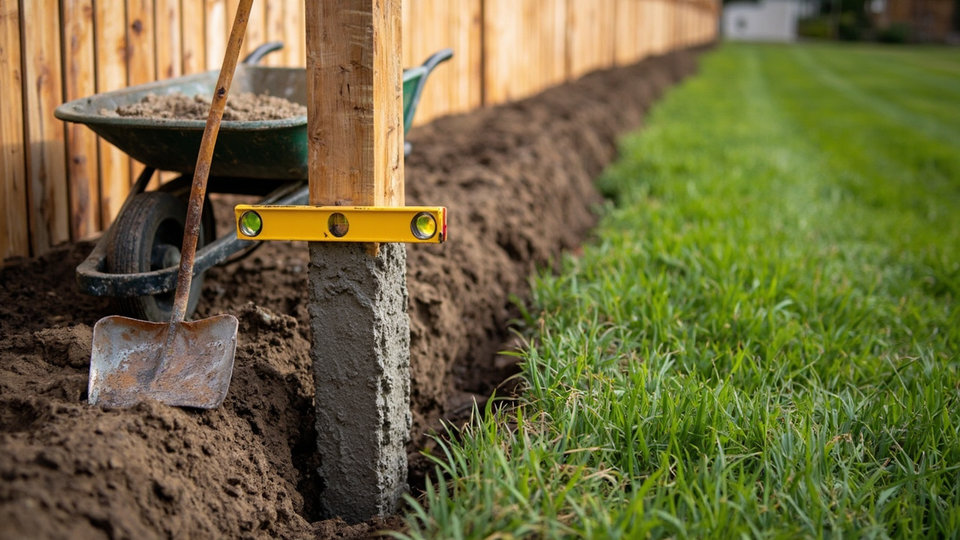
For a square post, make the post hole diameter about three times the post width. For a round post up to 4 inches across, use four times its largest cross-section. Concrete then surrounds the post rather than merely filling a narrow slot, giving the assembly more resistance to shifting.
Use a driven post where the soil is firm and a post driver can reach the required depth. Solid rock may require drilling, while loose sand and wet clay often benefit from a wider footing. When the hole will not hold its shape, widen it or use a form before placing concrete backfill.
- Mark the hole center and check for buried utilities before removing soil.
- Dig to the depth selected by the one-third, frost, and ASTM comparisons.
- Set the post plumb, then brace it before adding the footing material.
- Fill the hole around the post and confirm the post remains vertical.
- Allow the footing material to reach its specified cure time before loading the fence.
Check the post again after curing and before attaching rails. A slight lean while wet concrete cures is easier to correct than a crooked line discovered after the panels are installed.
Corner, End, and Gate Posts Need More Depth Than Line Posts
Gate and corner posts carry different loads than line posts, so the standard 4-to-6-foot fence depth may not be enough. The gate post depth depends on gate weight, hinge spacing, soil, and frost depth, while corner and end posts resist loads from two fence directions.
Michigan State’s fence specification recommends deeper footings for these roles, including approximately 42 inches for corner and gate posts in certain conditions. That figure is a specification example, not a national rule. The practical result is that you should treat 42 inches as a starting point and deepen it when frost, soil, or gate load requires.
A swinging gate turns its post into a cantilever. The post receives repeated leverage as the gate opens, closes, and settles. A heavy gate, wide leaf, wide hinge spacing, or strong wind exposure can make the usual line-post depth inadequate even when the surrounding fence looks ordinary.
Choose a deeper gate-post footing when the gate is heavy, its leaf is wide, or the hinges are spaced far apart. For a light gate in firm soil, the ordinary depth calculation may suffice, but the frost requirement still applies. See our deck footing depth guidance for the same embedment-versus-frost principle in a different structure.
Concrete, Gravel, or Dirt, and How Each Holds a Post
Concrete footing provides the stiffest support and works well in sandy soil, but it can trap moisture against wood. Gravel backfill drains well and allows some movement, making it useful in stable soil with moderate loads. Direct soil backfill is simplest and often suitable for lightweight fences, provided the soil is firm.
| Filling method | Best fit | Main limitation | Decision |
|---|---|---|---|
| Standard concrete | Sandy soil, gate posts, exposed sites | Long cure time; moisture retained at wood surface | Choose when stiffness and a controlled footing matter most. |
| Fast-setting concrete | Small posts and repairs | Limited working time; roughly 15-20% more per bag | Choose only when its rated depth and load suit the post. |
| Gravel | Firm soil and well-drained line posts | Less restraint than concrete | Choose when drainage matters and loads are moderate. |
| Packed soil | Light fences in compact, stable soil | May settle or heave | Choose for low loads after assessing frost and soil. |
For concrete, use a 4-6 in. gravel base where the design calls for drainage, then fill around the post without displacing too much of the footing volume. Avoid adding water after the initial mix, because extra water lowers strength. The concrete mix and curing guidance explains why the water ratio and cure time affect the finished footing.
Choose standard mix when you can wait for full cure and need greater load resistance. Choose fast-setting mix for a light-duty post or repair when its published working time and depth limit fit the job. In very wet clay, improve drainage around the assembly; in sandy soil, use a broader footing; in rocky ground, confirm that digging will reach the required depth.
Watch for three common errors: setting the post on loose soil, backfilling the top with gravel, and using a shallow hole because the post looked long. A square post that is 6 inches wide normally needs an 18-inch hole, but frost, ASTM depth, soil, and post role can still push the required depth well beyond 18 inches.
Decision Guidance for Your Fence Post Depth
Choose a depth that satisfies every applicable check, not just one memorable rule. For an ordinary line post, start with one third of the post length, compare it with the local frost depth plus 6 inches, and check the ASTM ladder. The deepest result governs.
- Choose a deeper footing when the frost line reaches below the one-third depth, even if the post already seems long enough.
- Choose a concrete footing when the soil is sandy, the post carries a gate, or wind and gate loads make stiffness important.
- Choose gravel or soil backfill when drainage, ease of adjustment, and moderate loads matter more than maximum rigidity.
- Choose the deepest standard footing for corner, end, gate, and pull posts when the fence line or gate applies repeated leverage.
Before digging, record the post length, fence height, gate weight, soil type, and jurisdiction’s frost depth. Then calculate the depth and diameter, mark the utilities, and set the first post as a test. That one carefully placed post can save the rest of the line from repeating the same mistake.