
The kitchen that ends up with three appliances that don’t talk to each other isn’t a bad-luck story — it’s a buying-order story. The cheapest oven, the best-rated cooktop, and the most powerful rangehood each made sense individually, but no one spec’d them as a package before the first one was ordered.
Oven, cooktop, rangehood, and dishwasher have to match on dimensions, fuel type, electrical circuit capacity, and ventilation — and the homeowner who picks them in isolation ends up with a package that doesn’t fit, doesn’t vent, or doesn’t talk to the existing infrastructure.
This page walks the four main kitchen appliances as a package — with the matching dimensions, the licensed-tradesperson requirements, and the spec to write before the first appliance order goes in.
Why the Appliances Are a Package, Not a Collection
An appliance package is a set of four — oven, cooktop, rangehood, dishwasher — spec’d together so the dimensions, fuel type, and infrastructure line up before anything gets ordered. The mechanism is simple: each appliance imposes a constraint on the others. A 90 cm cooktop demands a wider rangeh
The constraint that surfaces last is usually the electrical circuit capacity. A typical Australian kitchen might have one 15 A circuit for the oven and one 16 A circuit for the cooktop. Swap the electric oven for a 32 A induction cooktop and the existing circuit won’t carry it — the licensed electrician has to run a new line from the switchboard, and that often means chasing the wall or
Oven — Built-in, Freestanding, or Wall-Mounted
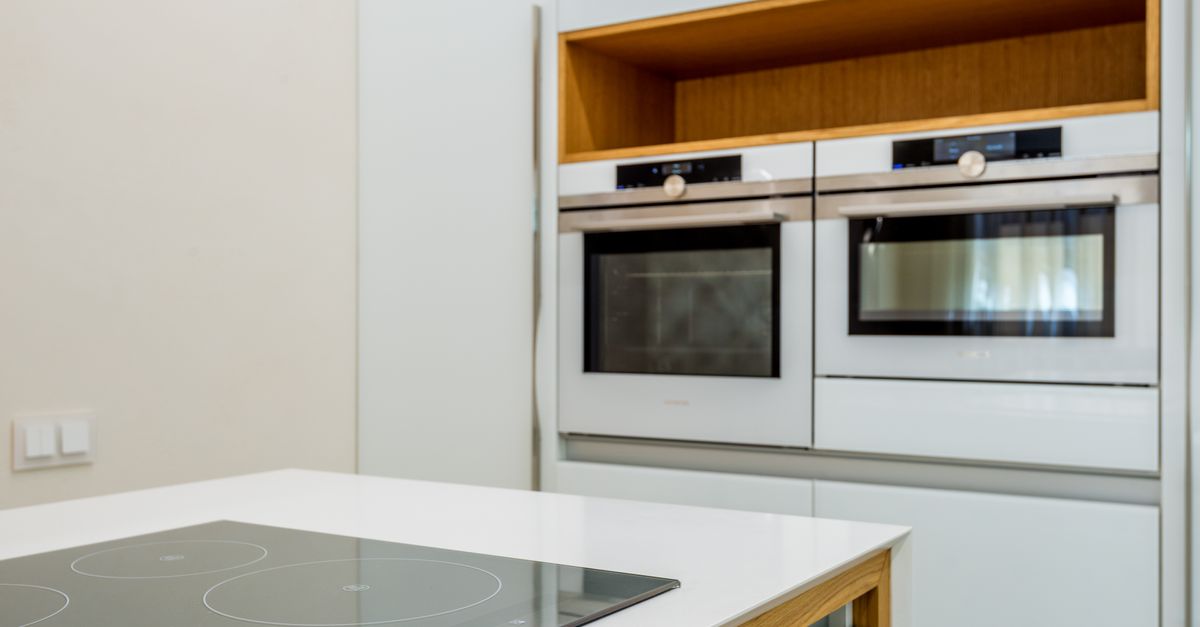
The oven decision splits into three formats, and the right one depends on the cabinet layout and how the household actually cooks. A built-in oven fits a standard 60 cm cabinet cutout and sits at bench height — it’s the most common choice in Australian renovations because it integrates with the cabinetry and frees up the cooktop zone above. A freestanding oven combines cooktop and oven in a single unit, which works in smaller kitchens where a separate cooktop cutout isn’t practical, but it locks the cooktop height to bench level and limits the cooktop choice to whatever the freestanding unit offers. A wall-mounted oven sits at eye level, which is easier on the back for anyone who bakes regularly, but it requires a tall cabinet housing and a structural fixing point — the wall cavity needs a stud or a mounting board, and the cabinet installer has to confirm the fixing before the oven goes in.
The premium segment adds two more options. A steam oven (combi-steam) bakes with injected moisture, which is useful for bread and pastry, but it needs a water connection and a drain — that’s a licensed plumber job if the water line isn’t already within 1.5 m. A pyrolytic self-cleaning oven runs a high-heat cycle that burns off residue, which is convenient but pulls a heavy electrical load during the cycle — confirm the dedicated circuit can carr
Cooktop — Gas, Induction, Ceramic, or Dual-Fuel
The cooktop is where fuel type and infrastructure collide. A gas cooktop gives instant heat control and works during a power outage, but it requires a gas bay within reach of the cooktop location and a licensed gas fitter to connect it — in Australia, that’s AS/NZS 5601 territory, and a handyman connection is a compliance risk. An induction cooktop heats the pan directly through a magnetic field, which is faster and safer than gas, but it typically needs a 32 A dedicated circuit — if the existing kitchen only has a 16 A circuit for the cooktop, the licensed electrician has to run a new line. A ceramic cooktop uses radiant heat under a glass surface, which is the slowest to heat and cool, but it runs on a standard 16 A circuit and doesn’t require a gas connection — it’s the fallback when neither gas nor a 32 A circuit is available.
The premium option is a dual-fuel cooktop — gas hob paired with an electric oven — which gives the cook the gas control they want for the hob and the even heat they want for the oven. The catch is that it needs both a gas connection and a dedicated electrical circuit for the oven, so the infrastructure requirement is the highest of the four options. The cooktop cutout is the other constraint: standard widths are 60 cm and 90 cm, and the cutout dimension has to match the cooktop spec exactly — a 90 cm cutout won’t accept a 70 cm cooktop without a filler panel, and a 60 cm cutou
Rangehood — Sized to the Cooktop
T
The ducting run is where most rangehood installs fall short. A ducted rangehood vents to the outside and is the preferred option wherever the structure allows — it removes heat, moisture, and combustion byproducts instead of filtering and recirculating them. A recirculating rangehood passes the air through a charcoal filter and returns it to the kitchen, which is the fallback when there’s no wall or roof access for ducting, but the filter needs replacing every 3–
The mounting style follows the kitchen layout. An island-mount rangehood hangs from the ceiling above a cooktop on an island — it needs structural support in the ceiling cavity and a longer duct run to reach the nearest wall or roof, which is why it’s the most expensive option. An under-cabinet rangehood slides out from under a wall cabinet and is the budge
Dishwasher — Built-in, Freestanding, or Drawer
The dishwasher decision is less about cooking and more about cabinetry and plumbing. A built-in dishwasher is the standard in Australian kitchens — it’s 60 cm wide, fits under the bench, and can be integrated with a cabinet panel or left with a visible front. A freestanding dishwasher sits as a standalone unit, which is useful in a rental or a kitchen where the cabinetry can’t be modified, but it takes up floor space and doesn’t look as clean. A drawer dishwasher — single or double drawer — is the premium compact option, and it works well in smaller kitchens or as a secondary unit in a scullery, but the per-drawer capacity is lower and the purchase price is higher than a full-size built-in.
The plumbing constraint is the one that surprises most homeowners. A dishwasher needs a 3/4-inch water inlet and a drainage connection — and the water temperature matters. A dishwasher connected to cold water runs longer cycles and uses more energy because it has to heat the water interna
The other spec that matters in open-plan kitchens is noise level. A dishwasher rated at 55 dB is audible across a living area; a dishwasher rated at 45 dB or lower is barely noticeable. In an open-plan layout, spec the dishwasher at 45 dB or lower — the difference is usually AUD 200–500 in purchase price, but it’s the difference between a dishwasher that runs after dinner and one that runs during dinner without anyone noticing.
Matching the Package to the Kitchen Layout
The kitchen layout determines which appliance formats are practical and which are forced compromises. A galley kitchen — cooking line on one wall — is the most forgiving: the oven goes in a tall cabinet at one end, the cooktop sits on the bench, the rangehood mounts under the cabinet above the cooktop, and the dishwasher tucks under the bench near the sink. The linear layout means the ducting run is short and the plumbing connections are close together. An L-shaped kitchen puts the tall oven and fridge in the corner zone, which frees up the main bench for the cooktop and dishwasher — but the corner cabinet has to be deep enough for the oven housing, and the cooktop can’t sit too close to the corner or the rangehood won’t have clearance.
A U-shaped kitchen gives the most bench space and the best work triangle, but the three walls mean the ducting run for the rangehood may have to travel farther to reach an outside wall — plan the duct path before spec’ing the rangehood CFM. An island kitchen is the hardest layout for appliance packaging: the cooktop often lands on the island, which means the rangehood has to be either a downdraft (compromised extraction) or an island-mount (expensive, structural support in the ceiling). The dishwasher usually goes on the perimeter wall near the sink, which is straightforward, but the island cooktop adds a gas-line or electrical-circuit run across the floor — that’s a licensed trade job and a structural-floor consideration. For a breakdown of how each layout affects the work triangle and appliance placement, see the kitchen layout types comparison.
A small kitchen — under 8 m² — forces compact formats: a 45 cm dishwasher instead of 60 cm, a 60 cm oven instead of 90 cm, and a 60 cm cooktop instead of 90 cm. The appliance package still has to match on dimensions and infrastructure, but the compact formats have fewer options and sometimes a higher per-unit cost. An open-plan kitchen adds the noise constraint: spec a 45 dB dishwasher and a silent rangehood, and confirm the rangehood CFM is high enough to clear the larger air volume of the combined kitchen-living space. Plan the appliance locations with the kitchen designer before buying the first appliance — the layout locks the format options, and the format options lock the infrastructure requirements.
What to Specify in Writing
The appliance quote that just lists “oven, cooktop, rangehood, dishwasher” is a red flag. The spec that prevents late-stage rework is a single appliance schedule that carries, for each appliance: brand, model number, dimensions, electrical requirement (voltage, amperage, dedicated circuit), gas supply type (natural gas or LPG, bay location), water connection (3/4-inch, hot vs cold), drainage type (high-loop or air-gap), and ventilation (CFM, ducting spec, max two bends). That schedule goes to four people: the cabinet installer (cutouts and clearances), the licensed electrician (circuits and switchboard capacity), the licensed gas fitter (gas line and bay), and the licensed plumber (water and drainage). If any one of those four can’t confirm their piece from the schedule, the package doesn’t fit — and it’s cheaper to find out on paper than after the walls are closed.
The licensed-trades requirement is non-negotiable in Australia. Any new circuit needs a licensed electrician per AS/NZS 3000. Any new gas line needs a licensed gas fitter per AS/NZS 5
The warranty terms are the last line of defence. Confirm whether the warranty covers parts only or parts plus labour, whether in-home service is included or whether the appliance has to be dropped off, and whether the warranty is voided by an unlicensed installation. In most cases, a licensed-trades installation is a warranty condition —