
In a busy kitchen, the hardware you pick can quietly shape how long a cabinet looks sharp and works smoothly. Think of three guarantees: doors stay aligned, drawers slide without sticking, and every slam is absorbed, not resisted. The right hardware adapts to your cabinet material, door weight, and daily rhythm, while staying within budget.
If you’re choosing hinges, slides, or dampers for new cabinetry or a retrofit, this guide helps you match three critical specs for hinges and three for slides to your setup–without the guesswork. In the field, an experienced installer usually confirms door weight, carcass material, and overlay type before fitting the first hinge; get these three right and the install is straightforward.
What Kitchen Cabinet Hardware Actually Has to Do
Hardware has three jobs: hold the door aligned, hold the drawer aligned, and absorb the slam. If any one element is off, the kitchen starts looking tired within months. For a quick audit, track these native components and how they interact with each other: concealed hinge (European cup hinge), soft-close hinge, drawer slide (side-mount, undermount), load rating, cabinet carcass, and door weight.
Across materials, the mounting interface and the volume the hardware must absorb drive long-term performance. A bright takeaway: the same hinge that sits flush against a plywood carcass can reveal quick divergence when mounted to particleboard if the mounting plate pulls out over time. For a durable result, plan the assembly around the carcass and door load together, not as separate decisions.
In practice, you’ll often see a set where concealed hinges are paired with soft-close dampers, and drawer slides span the full depth of the cabinet to hide the hardware and maximize drawer capacity. The combination determines whether the kitchen feels premium or merely functional after several years of daily use.
For readers upgrading or retrofitting, the takeaway is simple: verify the three hinge specs–cup diameter, cup depth, and overlay type–and the three slide specs–drawer depth, load rating, and box type–before ordering. If any mismatch occurs, the install becomes a fight with misaligned doors and binding drawers.
Hinges: Concealed, Soft-Close, and the Numbers That Matter
The default for new cabinetry is a concealed cup hinge, and soft-close is a common add-on rather than a separate hinge family. Key dimensions and options influence fit and performance: cup diameter (35 mm), cup depth (11.5 mm), and overlay vs inset vs partial overlay, plus the mounting plate style. Major brands–Blum, Hettich, Grass, and Salice–provide standard data sets that fit most European and Australasian kitchens, but you still need to confirm the exact fit against your cabinet cutouts and door weight.
Concealed hinges are typically designed to sit behind the door with a 35 mm cup that accepts a 35 mm bore in the door. A 11.5 mm cup depth aligns with common door thicknesses; if your door is substantially thicker or thinner, you’ll need a different cup depth or a specialty hinge. The overlay type–whether the door overlays the cabinet box fully (full overlay), covers part of the frame (partial overlay), or sits flush (inset)–drives hinge placement and mounting plate alignment. Clip-on mounting plates simplify installation, but you must still verify screw size and spacing to prevent fasteners from bottoming out in the carcass.
In a practical sense, the hinge choice is paired with a damper or soft-close mechanism, because soft-close dampers live within the hinge body and absorb the slam during closing. If you’re renovating for accessibility or multi-generation households, soft-close on every door often delivers a smoother, safer experience for children and seniors. For premium performance, pair concealed hinges with soft-close units from a single brand to ensure consistent operation and lubrication life.
In the field, a common failure is not the hinge itself but the mounting plate pulling away from the cabinet carcass–especially on particleboard. The hinge fit may be correct, but mounting integrity determines early-life performance. Choose mounting plates rated for your carcass type and ensure fasteners are long enough to bite into a solid substrate or use screw anchors where needed.
Practitioner line
In the field, the failure mode that shows up most often on a five-year-old kitchen is not the hinge itself but the mounting plate coming loose from a particleboard carcass — the hinge was right, the carcass was wrong, and the fix is a different problem.
Drawer Slides: Side-Mount, Undermount, and Load Rating
Drawer slides come in two broad families: side-mount and undermount. The choice affects how the drawer box carries weight, how the hardware hides, and how smooth the action remains over years of use. A side-mount, typically ball-bearing slide, is cheaper and easier to replace, but the drawer box sides become the wear surface; undermount slides hide the hardware and rely on the drawer box for vertical load distribution, often delivering the ability to support heavier loads with a cleaner interior appearance.
Load rating is a practical, not aspirational, measure. Typical household use assigns per-pair ratings in the 20–60 kg range for undermount options, depending on the slide quality and the drawer box construction. When you’re planning a kitchen with heavy user profiles (e.g., pot drawers or full-extension pantry drawers), select slides with a higher rating and confirm the drawer box is designed to carry that load without sag. A robust drawer box–metabox or side-mounted box–paired with a compatible slide reduces early wear and keeps alignment intact.
Another factor is soft-close dampers on slides. A damper can prevent slamming and extend the life of both the drawer front and the cabinet face frame. However, dampers can also accumulate cooking grease over time, reducing effectiveness if not cleaned or replaced. Always verify the damper’s cycle rating and consider maintenance access during service planning.
In the field, undermount slides often deliver superior drawer alignment and smoother travel, but they require precise cutouts and a strong carcass to support the weight without flex. Side-mount slides reward ease of installation and serviceability, making them popular for retrofit projects where carcass strength may be variable.
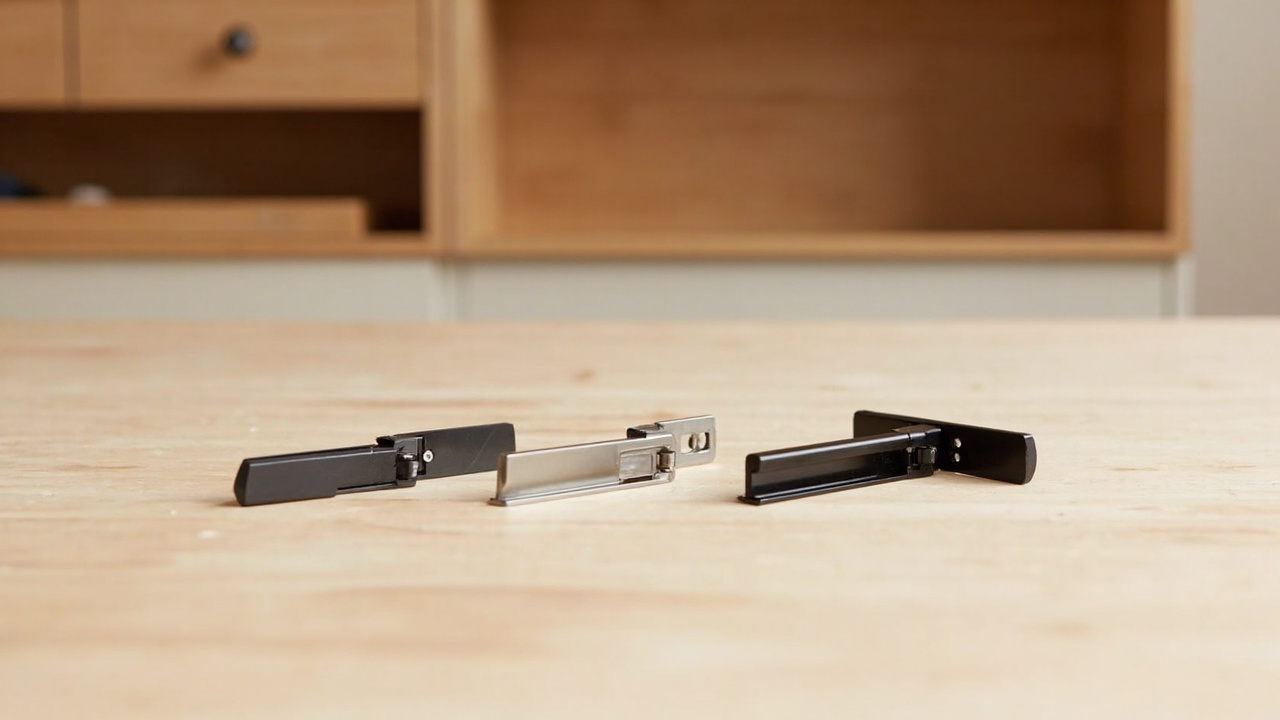
Practitioner line
In the field, undermount slides typically carry 30 to 60 kg per pair at trade price, while side-mount ball-bearing slides offer lower cost but shift wear to the drawer box sides.
Soft-Close, Push-to-Open, and the Damping Question
Soft-close is a hydraulic damper either built into the hinge or integrated with the slide. A push-to-open mechanism trades the handle for a mechanical catch and can be used in high-cleanliness kitchens or where a handleless look is desired. Neither is mandatory, but for homes with children or elderly users, a fully soft-close setup across doors and drawers is a sensible default to reduce wear and abrupt closures.
The damping system must be compatible with the chosen hinge or slide. If you upgrade to push-to-open later, verify that the damper interface remains compatible with your existing hardware. When selecting dampers, check the rated cycle life and ensure the mechanism can survive normal daily demand without frequent replacement. Brands like Blum and Hettich offer integrated dampers with matched hinge types for predictable performance.
In practice, the choice between soft-close hinges and soft-close slides comes down to the cabinet design and user preference. For a child- or elder-friendly kitchen, applying soft-close everywhere reduces pinching hazards and prevents loud bangs on closing actions. Where a clean, handle-free appearance is prioritized, push-to-open can be combined with gradual-damping strategies to control the rate of closure and maintain alignment over time.
In the field, soft-close dampers are typically rated for tens of thousands of cycles, equating to many years of daily operation in a normal home. Regular checks during service visits can catch early signs of grease ingress or reduced damping before failure impacts alignment.
Practitioner line
In the field, soft-close dampers are usually rated for 50,000 to 100,000 cycles. In a household kitchen, that equates to roughly 10 to 20 years of daily use before damping performance declines.
How to Specify Hardware Without Getting It Wrong
Specification discipline saves installation time and future headaches. For hinges, specify three things: cup diameter, cup depth, and overlay type. For slides, specify three things: drawer depth, load rating, and box type. If any of these don’t match your cabinet, the installation will fight you from the start.
In detail, your hinge spec should confirm: cabinet carcass type and overlay (full, partial, or inset), cup diameter (35 mm standard), and cup depth (11.5 mm standard). For the slide spec, confirm: drawer depth, the required load rating per pair, and the drawer box type (side, undermount, or metabox). And always confirm mounting plate compatibility with the cabinet carcass, as this is a very common point of failure if the plate doesn’t have sufficient bite into the substrate.
With a careful spec, you avoid a mismatch between cabinet carcass material and mounting hardware. A robust spec makes it easier to source compatible components from Blum, Hettich, Grass, Salice, and other brands, and it speeds up installation as the vendor-provided hardware aligns with your measurements and intended loads.
For references in renovations and material discussions, refer to our cabinet hardware overviews in the cabinet carcass material discussion and the kitchen renovation guide.
As a quick practical step: measure each door and drawer system, list hinge cup diameter and depth, overlay type, drawer depth, and weight–then run a final check against the chosen brand data sheets before ordering. If any mismatch arises, adjust either the cabinet cut or the hardware kit to ensure a clean install with predictable performance.
Practitioner line
In the field, three hinge data points and three slide data points are enough to lock in a successful installation–cup diameter, cup depth, overlay; drawer depth, load rating, box type.
What Usually Fails First and How to Plan Around It
The first failure is rarely the hinge or drawer slide itself. More often, it’s the mounting plate pulling out of a particleboard carcass or the soft-close damper filling with cooking grease and losing damping. The fix is usually material choice and mounting strategy rather than swapping to a different brand mid-project.
To plan around this, choose a carcass material that can anchor fasteners securely (e.g., plywood backers or high-grade particleboard rated for cabinetry). Ensure the mounting plate and fasteners are appropriate for the substrate–if a fragile core is present, use longer fasteners or add a backing block to improve screw-holding strength. For dampers, select models with higher cycle ratings and plan for easier maintenance access in the cabinet interior to facilitate cleaning or replacement over time.
With well-matched components and a robust mounting plan, you reduce service calls and keep doors and drawers aligned after years of use. If you suspect a mounting issue after installation, check screw depth, plate type, and substrate integrity before swapping out hardware components.
Practitioner line
In the field, the mounting plate pulling out of a particleboard carcass is the most common early-life failure, not the hinge or slide itself.
For cross-link context and deeper planning, explore related guides on cabinet materials and layout strategy:
See: cabinet carcass material for substrate considerations, kitchen renovation guide, and kitchen layout comparison.
Additionally, for budgeting and cost breakdowns, consult the renovation cost breakdown, and for countertop pairing considerations, consult the countertop material guide.
For ventilation context relevant to kitchen hardware planning, see the kitchen ventilation guide, and for renovation pitfalls to avoid, browse the renovation mistakes. For ideas on compact kitchens where hardware decisions matter more, explore small kitchen ideas.