
Constant damp patches, peeling paint, or a quote that jumps after demolition? The problem is rarely the tile. Waterproofing systems are the continuous waterproof membrane and drainage layer that keep structure dry, where material composition and installation tolerances decide whether protection lasts five years or fifteen.
What Waterproofing Systems Cover and How They Fail
Waterproofing systems cover the continuous waterproof membrane, primer coat, and drainage composite that block water migration through concrete and joints. Unlike paint that repels surface droplets, a system creates a tray that laps up walls and seals penetrations so hydrostatic pressure cannot find a seam.
A home faces three water paths. Hydrostatic pressure pushes water up through slabs in high groundwater, capillary action pulls moisture sideways through porous blocks, and surface pooling sits on flat roofs until it finds a crack. Each path needs a different lap height and material.
Failure rarely announces itself at the leak. Cement render without a 150 mm wall upstand lets water slip behind ceramic tiles and appear as blistered paint in the next room. PVC drains set without fabric reinforcement crack at the joint after one thermal cycle.
In coastal homes you see a fourth clue: salt crystallization. When concrete slab breathes without a vapor barrier, efflorescence powders at the base and grout joints soften even though the roof never leaked.
How Waterproofing Works — Membrane, Lap, and Slope Mechanics
Liquid waterproof coating works by forming a 1.2 to 1.5 mm dry film that bridges hairline cracks up to 0.8 mm while fabric reinforcement at corners distributes stress. When applied at right angles in two coats, the film remains elastic across 35 to 45 degree roof surfaces without splitting.
Sheet bituminous membrane works differently. It bonds as overlapping rolls with 100 mm side laps and 150 mm end laps, torched or self-adhered to primed concrete substrate. The lap is the system — a 60 mm shortcut opens a capillary channel that draws water 200 mm inward in heavy rain.
Slope determines whether the membrane ever gets tested. A flat roof needs 15 to 25 mm fall per meter toward the drain outlet, checked with a 1200 mm level before application. On 10 sqm without fall, 8 to 12 liters can pond after a 20 minute storm.
Air gaps matter behind walls. A drainage board with 8 mm dimples against a retaining wall creates a 4 liter per meter channel that relieves pressure, while weep holes at 900 mm centers let the cavity dry. Without that, pressure can exceed 2 kPa and push water through a perfect membrane.
Choosing Between Membrane Types and What Each Costs
For exposed flat roofs that see direct sun and foot traffic, sheet membrane with mineral finish handles UV exposure and 70 degree surface temperatures without re-coating. Budget $12 to $18 per square meter for material and $22 to $35 installed when substrate is sound.
For bathrooms, balconies, and internal wet areas, cementitious coating at 1.0 to 1.2 mm with polymer additive bonds better to damp screed and accepts tile adhesive directly. Expect $6 to $10 per square meter material, $14 to $22 installed.
Choose polyurethane liquid membrane when details are complex — dozens of pipe penetrations or tight corners where sheets wrinkle. Its elongation at break above 400 percent survives movement at expansion joints that would split cementitious coats.
| Criteria | Sheet Bituminous Membrane | Cementitious Coating | Polyurethane Liquid |
|---|---|---|---|
| Best Use | Exposed roofs, terraces with UV | Bathrooms, balconies, basements | Complex details, movement areas |
| Dry Film Thickness | 3.0 to 4.0 mm (sheet) | 1.0 to 1.2 mm | 1.2 to 1.5 mm |
| Lap / Reinforcement | 100 mm side, 150 mm end | Fabric at corners only | Fabric at all joints |
| UV Resistance | High with mineral cap | Low — needs screed cover | Medium — needs top coat |
| Cost per sqm Installed | $22 to $35 | $14 to $22 | $18 to $28 |
| Lifespan if Detailed Correctly | 12 to 18 years | 8 to 12 years | 10 to 15 years |
Do not compare material price alone. A $6 sheet saving that skips primer and 100 mm laps fails within two monsoons, while a $14 coating with correct upstand height and protected drain flashings outlasts a cheap roof. Calculate over ten years.
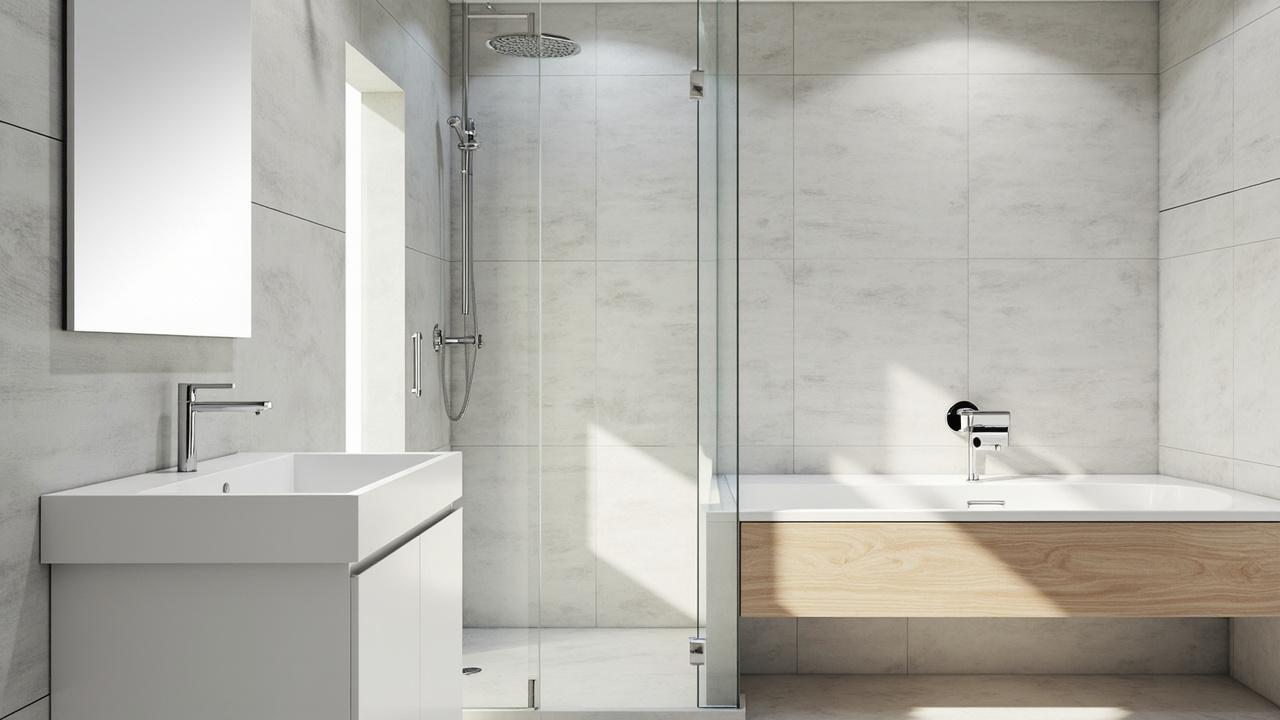
For interiors see how bathroom tile versus vinyl flooring performs when the substrate stays dry, and how bathroom layout and fixtures placement affects where you need upstands and slopes.
Installation Sequence and Mistakes That Cause Leaks Within Months
Install in order and test before covering. First, repair the concrete substrate — fill honeycombs with repair mortar and cure 24 hours, then prime at 0.15 liter per square meter and let it tack.
Second, reinforce all corners, drains, and pipe sleeves with 100 mm fabric tape bedded in wet liquid membrane. Skipping this saves 30 minutes and guarantees a corner crack at the first heat cycle.
Third, apply two coats at right angles to reach specified dry film thickness, measuring wet film with a gauge. For bituminous sheets, roll laps with a 2 kg roller until bitumen bleeds 3 to 5 mm at the edge — that bleed is your proof.
Fourth, flood-test for 24 hours by plugging the drain outlet and holding 25 mm of water. A loss over 2 mm means a pinhole at a lap that must be patched before screed. Many quotes skip this to save a day.
Fifth, protect the system — 30 mm protective screed on roofs, drainage board against walls — before other trades step on it. One wheelbarrow over an unprotected polyurethane coat punctures 0.6 mm film you will not see until the next leak.
Limits, Edge Cases, and Your Next Move
No system is universal. On timber decks that deflect over 2 mm per 600 mm, rigid cementitious coating cracks even at 1.2 mm. Use polyurethane with decoupling or sheet over plywood substrate rated for wet areas.
In high water table basements where pressure is constant, internal coating alone fails. You need an external drainage composite plus sump pump with standby power. Coating inside without drainage holds water like a bowl and blisters within months.
For sun-exposed parapets that cycle 25 to 65 degrees daily, dark bituminous membrane without reflective protective coating softens and tracks underfoot. Specify a light acrylic top coat that drops surface temperature 12 to 18 degrees.
Choose sheet membrane if the area is exposed, flat, and sees foot traffic. Choose cementitious coating if the area is internal, tiled, and the substrate stays damp. Choose polyurethane if details are dense or movement is expected near expansion joints.
Photograph the area from four corners, measure the longest fall to the drain outlet, and note upstand height around pipes before asking for a quote. Request the specified dry film thickness, lap dimensions, and flood-test record in writing.
Compare options in our home renovation budget guide to allocate waterproofing spend against finish choices, and see quartz countertops for how substrate flatness standards carry across wet and dry zones. For structural cracks wider than 1 mm, active leaks under pressure, or electrical near wet areas, consult a professional.