
You stand in an unfinished basement staring at cold concrete walls. You want them warm and finished but are unsure whether rigid foam board or mineral wool fits. The answer depends on moisture and fire code. Pick mineral wool if moisture is a concern or fire compliance matters; pick rigid foam board for dry walls where space and R-value per inch matter most. This comparison breaks down the five differences that decide it.
How R-Value and Vapor Behavior Decide Your Material Choice
The core difference is thermal resistance and moisture handling. XPS rigid foam board delivers around R-5 per inch and blocks both air and vapor completely. Mineral wool runs lower at R-3.0 to R-3.3 per inch but lets vapor pass through, which helps a wall assembly dry out instead of trapping moisture inside.
That distiction matters because wet concrete keeps releasing vapor. If you seal it with closed-cell foam, moisture can migrate to the next layer or collect at the interface. A breathable material like mineral wool gives the wall a path to dry. EPS boards sit in between at R-3.6 to R-4.2 per inch but stay vapor-tight, so they carry a similar trapping risk in humid zones.
In a dry basement with low vapor pressure, that impermeability becomes a feature. XPS creates a continuous thermal barrier without a separate vapor retarder. The right material for your moisture profile outperforms the wrong one, no matter the thickness.
Fire Safety and Compressive Strength Define Structural Limits
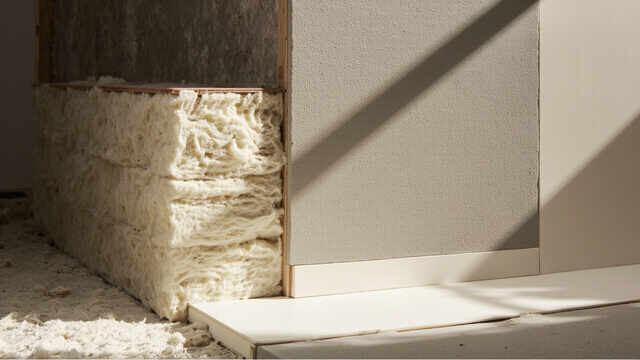
Mineral wool is non-combustible and passes the ASTM E136 test, which makes it the default for fire-rated basement assemblies in many places. Rigid foam board is a combustible material and needs at least 5/8-inch gypsum board covering it wherever occupants meet the wall. That covering adds cost and work to a foam installation.
Compressive strength separates the two sharply. XPS boards rate from 100 to 1000 psi, so they take buried backfill or framing loads without deforming. Mineral wool relies on framing to hold it and cannot carry structural loads or handle impact the way boards can.
Where fire codes apply, non-combustible mineral wool is the safe default. It will not melt, drip, or feed a fire. Visible masonry or no drywall behind insulation leaves mineral wool as the only code-friendly option.
Installed Cost and Space Constraints Shape the Budget
EPS boards cost the least, roughly $0.50 to $0.80 per square foot installed for basic work. Mineral wool batts run $0.75 to $1.10, and XPS boards range from $1.00 to $1.50 depending on thickness and adhesive. Labor dominates because rigid boards need adhesive or fasteners that take time.
Space is the hidden cost. Matching four inches of XPS at R-5 per inch takes five inches of mineral wool near R-3.3. In a low-ceiling basement, that extra inch can push framing closer to the joist or shrink usable floor space. Measure your wall cavity depth first. Three inches of space usually leaves only XPS with enough R-value.
Pick EPS when the budget is tight and the basement stays dry. It gives the best R-value per dollar. Pick XPS when you need maximum R-value in thin space, paying more for better performance in a cramped frame.
Common Installation Mistakes That Ruin Performance
The most frequent error is thermal bridging at studs. Compressed mineral wool around studs creates conductive paths that drop real wall R-value by 10 to 20 percent. Pack batts loosely against the stud face without forcing them into tight cavities. A rigid foam board layer against the concrete strips out that bridging, as long as there are no gaps between board and concrete.
Vapor barrier placement decides whether foam works. Put XPS against concrete and then add drywall, and you trap a vapor-impermeable layer. In cold weather that layer can condense on the interior face. Persistent moisture problems need a professional look, because the real fix is often exterior waterproofing rather than interior insulation alone.
For mineral wool, the risk is saturation after a leak. The material stays wet and loses R-value. Drying takes time. A basement with past flooding or weeping walls needs the water source fixed first, before any insulation goes in.
Final Decision: Which Material for Your Basement
Match the material to the dominant constraint. Choose mineral wool if moisture is your main worry, because it breathes and dries, and it satisfies fire codes that need non-combustible material. Choose rigid foam board if your basement is dry and you need high R-value in a thin space; it blocks vapor and cuts thermal bridging well.
If budget rules, start with EPS. It delivers the best R-value per dollar but needs careful gap sealing. If you have the depth, layer EPS against the wall and add studs to stack performance without paying XPS prices. Check local building codes for required fire separation before finalizing anything.
Next steps depend on what you find. A moisture issue belongs in basement waterproofing methods before you insulate. Finish the full sequence through the basement renovation guide so framing and finish match your insulation choice. Picking the right material for the right basement saves the waste of installing the wrong one in the wrong environment.